Over 50 years ago, astronomers launched the world's first orbiting telescope to gaze further into outer space to examine anything that appears in the sky above our heads, from comets and planets to galaxy clusters and stars. Since then, almost 100 space telescopes have been launched from Earth and are orbiting our planet, with 26 still active and relaying information back to us.
As a result of these space-based instruments, such as NASA's iconic Hubble Space Telescope, we know much more about the universe now than we did half a century ago. But why is Hubble, orbiting just 540 kilometres above the Earth, so much more effective than a ground-based telescope? How can a glorified camera tell us not only what distant objects look like, but their detailed chemical composition and three-dimensional structure as well?
In
Eyes in the Sky, science writer Andrew May takes us on a journey into space to answer these questions and more by looking at the development of revolutionary instruments, such as Hubble and the James Webb Space Telescope, exploring how such technology has helped us understand the evolution of the Universe.
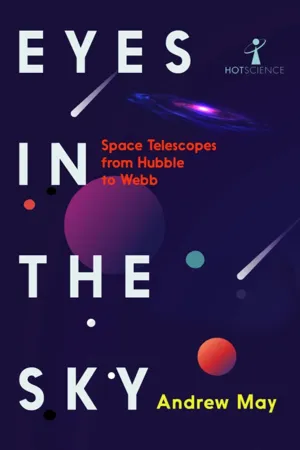
- 176 pages
- English
- ePUB (mobile friendly)
- Available on iOS & Android
eBook - ePub
About this book
Information
Topic
Physical SciencesSubtopic
Astronomy & AstrophysicsTable of contents
- Cover
- 1 Space and Telescopes
- 2 Hubble
- 3 Probing the Big Bang
- 4 Exoplanet Hunters
- 5 Mapping the Galaxy
- 6 Webb
- 7 High-energy Astronomy
- 8 The Future
- Further Reading
Trusted by 375,005 students
Access to over 1.5 million titles for a fair monthly price.
Study more efficiently using our study tools.
Frequently asked questions
Yes, you can cancel anytime from the Subscription tab in your account settings on the Perlego website. Your subscription will stay active until the end of your current billing period. Learn how to cancel your subscription
No, books cannot be downloaded as external files, such as PDFs, for use outside of Perlego. However, you can download books within the Perlego app for offline reading on mobile or tablet. Learn how to download books offline
Perlego offers two plans: Essential and Complete
- Essential is ideal for learners and professionals who enjoy exploring a wide range of subjects. Access the Essential Library with 800,000+ trusted titles and best-sellers across business, personal growth, and the humanities. Includes unlimited reading time and Standard Read Aloud voice.
- Complete: Perfect for advanced learners and researchers needing full, unrestricted access. Unlock 1.5M+ books across hundreds of subjects, including academic and specialized titles. The Complete Plan also includes advanced features like Premium Read Aloud and Research Assistant.
We are an online textbook subscription service, where you can get access to an entire online library for less than the price of a single book per month. With over 1.5 million books across 990+ topics, we’ve got you covered! Learn about our mission
Look out for the read-aloud symbol on your next book to see if you can listen to it. The read-aloud tool reads text aloud for you, highlighting the text as it is being read. You can pause it, speed it up and slow it down. Learn more about Read Aloud
Yes! You can use the Perlego app on both iOS and Android devices to read anytime, anywhere — even offline. Perfect for commutes or when you’re on the go.
Please note we cannot support devices running on iOS 13 and Android 7 or earlier. Learn more about using the app
Please note we cannot support devices running on iOS 13 and Android 7 or earlier. Learn more about using the app
Yes, you can access Eyes in the Sky by Andrew May, Brian Clegg in PDF and/or ePUB format, as well as other popular books in Physical Sciences & Astronomy & Astrophysics. We have over 1.5 million books available in our catalogue for you to explore.