- 338 pages
- English
- ePUB (mobile friendly)
- Available on iOS & Android
Iterative Learning Control over Random Fading Channels
About this book
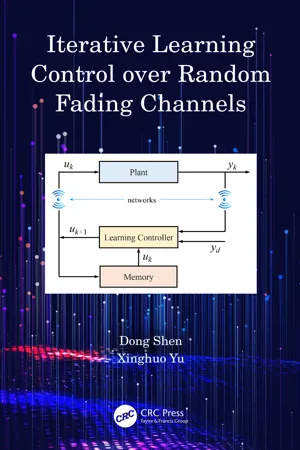
Random fading communication is a type of attenuation damage of data over certain propagation media. Establishing a systematic framework for the design and analysis of learning control schemes, the book studies in depth the iterative learning control for stochastic systems with random fading communication.
The authors introduce both cases where the statistics of the random fading channels are known in advance and unknown. They then extend the framework to other systems, including multi-agent systems, point-to-point tracking systems, and multi-sensor systems. More importantly, a learning control scheme is established to solve the multi-objective tracking problem with faded measurements, which can help practical applications of learning control for high-precision tracking of networked systems.
The book will be of interest to researchers and engineers interested in learning control, data-driven control, and networked control systems.
Frequently asked questions
- Essential is ideal for learners and professionals who enjoy exploring a wide range of subjects. Access the Essential Library with 800,000+ trusted titles and best-sellers across business, personal growth, and the humanities. Includes unlimited reading time and Standard Read Aloud voice.
- Complete: Perfect for advanced learners and researchers needing full, unrestricted access. Unlock 1.4M+ books across hundreds of subjects, including academic and specialized titles. The Complete Plan also includes advanced features like Premium Read Aloud and Research Assistant.
Please note we cannot support devices running on iOS 13 and Android 7 or earlier. Learn more about using the app.
Information
Table of contents
- Cover Page
- Half-Title Page
- Title Page
- Copyright Page
- Contents
- Preface
- Acknowledgments
- Author Bios
- Chapter 1 ▪ Introduction
- Section I Known Channel Statistics
- Section II Unknown Channel Statistics
- Section III Extensions of Systems and Problems
- Appendix A ▪ Technical Lemmas
- Bibliography
- Index