Before the advent of radio, conceptions of the relationship between science and religion circulated through periodicals, journals, and books, influencing the worldviews of intellectuals and a wider public. In this volume, historians of science and religion examine that relationship through diverse mediums, geographic contexts, and religious traditions. Spanning within and beyond Europe and North America, chapters emphasize underexamined regions—New Zealand, Australia, India, Argentina, Sri Lanka, Egypt, and the Ottoman Empire—and major religions of the world, including Christianity, Hinduism, Buddhism, Confucianism, and Islam; interactions between those traditions; as well as atheism, monism, and agnosticism. As they focus on evolution and human origins, contributors draw attention to European scientists other than Darwin who played a significant role in the dissemination of evolutionary ideas; for some, those ideas provided the key to understanding every aspect of human culture, including religion. They also highlight central figures in national contexts, many of whom were not scientists, who appropriated scientific theories for their own purposes. Taking a local, national, transnational, and global approach to the study of science and religion, this volume begins to capture the complexity of cultural engagement with evolution and religion in the long nineteenth century.
eBook - ePub
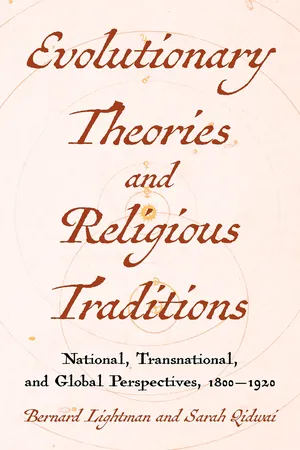
Evolutionary Theories and Religious Traditions
National, Transnational, and Global Perspectives, 1800–1920
- 400 pages
- English
- ePUB (mobile friendly)
- Available on iOS & Android
eBook - ePub
Evolutionary Theories and Religious Traditions
National, Transnational, and Global Perspectives, 1800–1920
About this book
Information
Table of contents
- Cover Page
- Title Page
- Copyright Page
- Contents
- Acknowledgments
- Introduction
- Part I | Empire and Colony
- Part II | Authority and Minority
- Part III | Appropriation and Response
- Coda | From Complexity to the Transnational
- Notes
- Select Bibliography
- Contributors
- Index
Trusted by 375,005 students
Access to over 1.5 million titles for a fair monthly price.
Study more efficiently using our study tools.
Frequently asked questions
Yes, you can cancel anytime from the Subscription tab in your account settings on the Perlego website. Your subscription will stay active until the end of your current billing period. Learn how to cancel your subscription
No, books cannot be downloaded as external files, such as PDFs, for use outside of Perlego. However, you can download books within the Perlego app for offline reading on mobile or tablet. Learn how to download books offline
Perlego offers two plans: Essential and Complete
- Essential is ideal for learners and professionals who enjoy exploring a wide range of subjects. Access the Essential Library with 800,000+ trusted titles and best-sellers across business, personal growth, and the humanities. Includes unlimited reading time and Standard Read Aloud voice.
- Complete: Perfect for advanced learners and researchers needing full, unrestricted access. Unlock 1.5M+ books across hundreds of subjects, including academic and specialized titles. The Complete Plan also includes advanced features like Premium Read Aloud and Research Assistant.
We are an online textbook subscription service, where you can get access to an entire online library for less than the price of a single book per month. With over 1.5 million books across 990+ topics, we’ve got you covered! Learn about our mission
Look out for the read-aloud symbol on your next book to see if you can listen to it. The read-aloud tool reads text aloud for you, highlighting the text as it is being read. You can pause it, speed it up and slow it down. Learn more about Read Aloud
Yes! You can use the Perlego app on both iOS and Android devices to read anytime, anywhere — even offline. Perfect for commutes or when you’re on the go.
Please note we cannot support devices running on iOS 13 and Android 7 or earlier. Learn more about using the app
Please note we cannot support devices running on iOS 13 and Android 7 or earlier. Learn more about using the app
Yes, you can access Evolutionary Theories and Religious Traditions by Bernard Lightman, Sarah Qidwai, Bernard Lightman,Sarah Qidwai in PDF and/or ePUB format, as well as other popular books in History & Religion & Science. We have over 1.5 million books available in our catalogue for you to explore.