- 279 pages
- English
- ePUB (mobile friendly)
- Available on iOS & Android
About this book
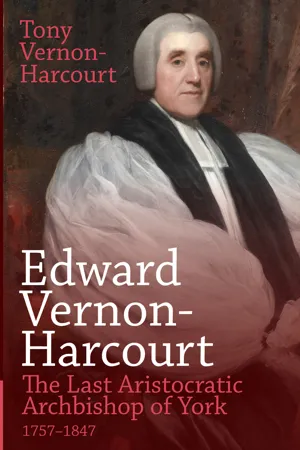
Edward Vernon-Harcourt (1757–1847) was Archbishop of York from 1807 until his death at the age of 90.
As a younger son of a wealthy land-owning family, Archbishop Harcourt depended on good family and political connections to make progress in the Church. He had to combine his responsibility for one of the largest dioceses in the Church of England with his duties in parliament and at court and with providing for his family of 16 children. More supportive of reform of both parliament and the church than most of his fellow bishops, Harcourt took steps to improve the training of ordinands in his diocese, encouraged the building of over 100 new churches to cope with population growth in the industrial towns of the West Riding and made some progress in tackling pluralism and non-residence. He was not afraid to stand up for a cause he believed to be right.
In this biography, Tony Vernon-Harcourt examines the professional and family life of one of the last aristocratic bishops in the Church of England.
Frequently asked questions
- Essential is ideal for learners and professionals who enjoy exploring a wide range of subjects. Access the Essential Library with 800,000+ trusted titles and best-sellers across business, personal growth, and the humanities. Includes unlimited reading time and Standard Read Aloud voice.
- Complete: Perfect for advanced learners and researchers needing full, unrestricted access. Unlock 1.4M+ books across hundreds of subjects, including academic and specialized titles. The Complete Plan also includes advanced features like Premium Read Aloud and Research Assistant.
Please note we cannot support devices running on iOS 13 and Android 7 or earlier. Learn more about using the app.
Information
Table of contents
- Preface
- Chapter 1. Early years (1757–91)
- Chapter 2. Bishop of Carlisle (1791–1807)
- Chapter 3. Becoming archbishop (1808–9)
- Chapter 4. The Archbishop in his diocese
- Chapter 5. Patronage and pluralities, nepotism and non-residence
- Chapter 6. The Archbishop’s contribution to music
- Chapter 7. Politics, royalty and reform
- Chapter 8. The later years (1830–47)
- Conclusion
- Appendix 1. Family members
- Appendix 2. Churches and burial grounds consecrated during Archbishop Harcourt’s archiepiscopate
- Appendix 3. Appointments in the gift of the Archbishop of York
- Acknowledgements
- Sources
- Bibliography
- Index