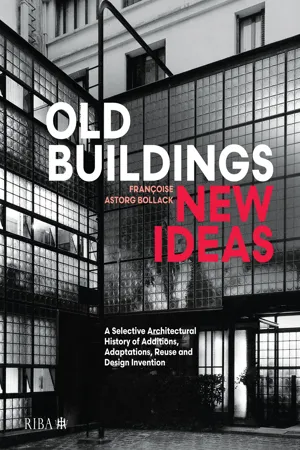
Some architectural transformations are modest, some are revolutionary. Shining a light on the hidden side of the accepted narrative of the history of architecture, this book explores works which transform existing buildings to build a way forward, through adaptations, additions and visual shifts. Examining 30 buildings across Europe, North America and South America, spanning from the early Middle Ages to the end of the 20th century, it demonstrates the creative possibilities of working with existing buildings. The book reveals how formal inventions can shape architecture and our environment over time in a built world constantly in a state of becoming. As we face a climate emergency, it taps into our deep cultural knowledge about the inventive use and re-use of buildings. Generously illustrated with architectural plans and over 300 colour images, it provides an alternative to the dominant view which sees conservation and preservation of historic buildings as a 20th century creation.
eBook - ePub
Old Buildings, New Ideas
A Selective Architectural History of Additions, Adaptations, Reuse and Design Invention
- 176 pages
- English
- ePUB (mobile friendly)
- Available on iOS & Android
eBook - ePub
Old Buildings, New Ideas
A Selective Architectural History of Additions, Adaptations, Reuse and Design Invention
About this book
Information
Topic
ArchitectureSubtopic
Architecture GeneralTable of contents
- Cover
- Title
- Copyright
- About the Author
- Acknowledgments
- Dedication
- Contents
- Foreword
- Introduction
- 1 6th to 15th Century: Roman Ruins as Shelter
- 2 15th to 18th Century: Continuity and Change
- 3 19th to Early 20th Century: Change in the Historic City
- 4 Early to Mid-20th Century: Modern Architects’ Attitudes to the Built World
- 5 Mid-20th Century: New Perspectives and the Post-War Reclamation of Urban Fragments
- 6 Late 20th Century: History as the Subject of Design
- Appendix: Wraps, Parasites, Insertions, Juxtapositions, Weavings - Typological Building List
- Bibliography
- References
- Index
- Image Credits
Trusted by 375,005 students
Access to over 1.5 million titles for a fair monthly price.
Study more efficiently using our study tools.
Frequently asked questions
Yes, you can cancel anytime from the Subscription tab in your account settings on the Perlego website. Your subscription will stay active until the end of your current billing period. Learn how to cancel your subscription
No, books cannot be downloaded as external files, such as PDFs, for use outside of Perlego. However, you can download books within the Perlego app for offline reading on mobile or tablet. Learn how to download books offline
Perlego offers two plans: Essential and Complete
- Essential is ideal for learners and professionals who enjoy exploring a wide range of subjects. Access the Essential Library with 800,000+ trusted titles and best-sellers across business, personal growth, and the humanities. Includes unlimited reading time and Standard Read Aloud voice.
- Complete: Perfect for advanced learners and researchers needing full, unrestricted access. Unlock 1.5M+ books across hundreds of subjects, including academic and specialized titles. The Complete Plan also includes advanced features like Premium Read Aloud and Research Assistant.
We are an online textbook subscription service, where you can get access to an entire online library for less than the price of a single book per month. With over 1.5 million books across 990+ topics, we’ve got you covered! Learn about our mission
Look out for the read-aloud symbol on your next book to see if you can listen to it. The read-aloud tool reads text aloud for you, highlighting the text as it is being read. You can pause it, speed it up and slow it down. Learn more about Read Aloud
Yes! You can use the Perlego app on both iOS and Android devices to read anytime, anywhere — even offline. Perfect for commutes or when you’re on the go.
Please note we cannot support devices running on iOS 13 and Android 7 or earlier. Learn more about using the app
Please note we cannot support devices running on iOS 13 and Android 7 or earlier. Learn more about using the app
Yes, you can access Old Buildings, New Ideas by Françoise Astorg Bollack in PDF and/or ePUB format, as well as other popular books in Architecture & Architecture General. We have over 1.5 million books available in our catalogue for you to explore.