An international discussion on adequate education and new forms of learning was embedded in post-1989 socio-political scenario, which increasingly pronounced a knowledge-based economy. The idea of a time-framed instruction restricted to initial life stages was outdated in a dynamic society, that had changed continuously due to socio-political, economic and technological transformations. The European Union reacted accordingly and suggested to make learning a lifelong and lifewide process promoting geographical mobility for educational and professional motivations in order to stimulate economic growth and personal advancement on the social ladder.
However, recent data shows that successful educational and professional integration and thus an adequate match of competences and occupational profiles is still unsatisfactory in numerous European contexts, especially when speaking of qualified mobility.
This volume tackles the issue of professional inclusion of knowledgeable migrants under consideration of the paradigmatic life course framework and aims to contribute to international research on human capital valorisation. It thus strives to investigate professional trajectories and corresponding skill utilisation of mobile workers in a highly heterogenous European labour market that constantly requires actions to combat unemployment, the waste of skills, the invisibility of (hidden) educational capital and the lack of needed qualifications of its potential workforce.
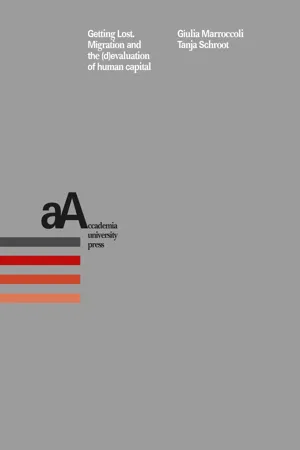
eBook - PDF
Getting Lost
Migration and the (d)evaluation of human capital
- 202 pages
- English
- PDF
- Available on iOS & Android
eBook - PDF
About this book
Trusted by 375,005 students
Access to over 1.5 million titles for a fair monthly price.
Study more efficiently using our study tools.
Information
Table of contents
- Introduction
- Section 1-Migration and human capital
- Section 2-Portraits of departures and mobility
- Section 3-From Italy to beyond: high-skilled people on the move
- Conclusion
- References
Frequently asked questions
Yes, you can cancel anytime from the Subscription tab in your account settings on the Perlego website. Your subscription will stay active until the end of your current billing period. Learn how to cancel your subscription
No, books cannot be downloaded as external files, such as PDFs, for use outside of Perlego. However, you can download books within the Perlego app for offline reading on mobile or tablet. Learn how to download books offline
Perlego offers two plans: Essential and Complete
- Essential is ideal for learners and professionals who enjoy exploring a wide range of subjects. Access the Essential Library with 800,000+ trusted titles and best-sellers across business, personal growth, and the humanities. Includes unlimited reading time and Standard Read Aloud voice.
- Complete: Perfect for advanced learners and researchers needing full, unrestricted access. Unlock 1.5M+ books across hundreds of subjects, including academic and specialized titles. The Complete Plan also includes advanced features like Premium Read Aloud and Research Assistant.
We are an online textbook subscription service, where you can get access to an entire online library for less than the price of a single book per month. With over 1.5 million books across 990+ topics, we’ve got you covered! Learn about our mission
Look out for the read-aloud symbol on your next book to see if you can listen to it. The read-aloud tool reads text aloud for you, highlighting the text as it is being read. You can pause it, speed it up and slow it down. Learn more about Read Aloud
Yes! You can use the Perlego app on both iOS and Android devices to read anytime, anywhere — even offline. Perfect for commutes or when you’re on the go.
Please note we cannot support devices running on iOS 13 and Android 7 or earlier. Learn more about using the app
Please note we cannot support devices running on iOS 13 and Android 7 or earlier. Learn more about using the app
Yes, you can access Getting Lost by Giulia Marroccoli,Tanja Schroot in PDF and/or ePUB format, as well as other popular books in Social Sciences & Emigration & Immigration. We have over 1.5 million books available in our catalogue for you to explore.