- 264 pages
- English
- ePUB (mobile friendly)
- Available on iOS & Android
About this book
How were whites implicated in and shaped by apartheid culture and society, and how did they contribute to it?
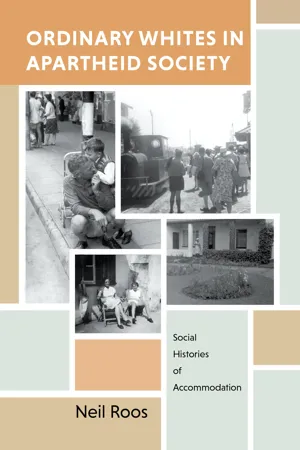
In Ordinary Whites in Apartheid Society, historian Neil Roos traces the lives of ordinary white people in South Africa during the apartheid years, beginning in 1948 when the National Party swept into power on the back of its catchall apartheid slogan. Drawing on his own family's story and others, Roos explores how working-class whites frequently defied particular aspects of the apartheid state but seldom opposed or even acknowledged the idea of racial supremacy, which lay at the heart of the apartheid society. This cognitive dissonance afforded them a way to simultaneously accommodate and oppose apartheid and allowed them to later claim they never supported the apartheid system.
Ordinary Whites in Apartheid Society offers a telling reminder that the politics and practice of race, in this case apartheid-era whiteness, derive not only from the top, but also from the bottom.
Frequently asked questions
- Essential is ideal for learners and professionals who enjoy exploring a wide range of subjects. Access the Essential Library with 800,000+ trusted titles and best-sellers across business, personal growth, and the humanities. Includes unlimited reading time and Standard Read Aloud voice.
- Complete: Perfect for advanced learners and researchers needing full, unrestricted access. Unlock 1.4M+ books across hundreds of subjects, including academic and specialized titles. The Complete Plan also includes advanced features like Premium Read Aloud and Research Assistant.
Please note we cannot support devices running on iOS 13 and Android 7 or earlier. Learn more about using the app.
Information
Table of contents
- Cover
- Title Page
- Copyright
- Dedication
- Contents
- Foreword
- Preface
- Acknowledgments
- 1. Compliance and Defiance in the Making of White Apartheid Society
- 2. Whites and South African History
- 3. The Delicacy of Teacups
- 4. Insluipers, Geoffrey Cronjé, and Social Policy
- 5. Work and Ideology in the Apartheid Public Service
- 6. Women, the Labor Market, and the Domestic Economy
- 7. Nationalism, Whiteness, and Consumption
- 8. Alcohol and Social Engineering
- 9. The End
- Notes
- Bibliography
- Index
- About the Author