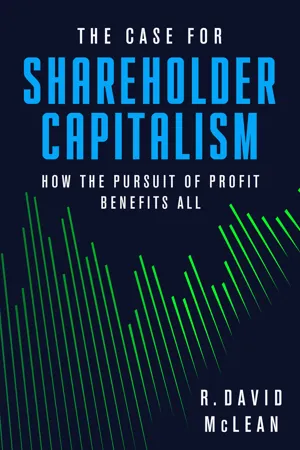
The Case for Shareholder Capitalism
eBook - ePub

The Case for Shareholder Capitalism

  1. English
  2. ePUB (mobile friendly)
  3. Available on iOS & Android
eBook - ePub

The Case for Shareholder Capitalism

About this book

Unlock the power of shareholder capitalism -- a system that transcends zero-sum games and Wall Street stereotypes. In its essence, shareholder capitalism enables mutually beneficial trade, a concept ingrained in our human history for over 300, 000 years. This approach fosters specialization, fuels innovation, and propels economic growth.

In this engaging new book, David McLean explains how embracing shareholder capitalism doesn't negate the significance of other institutions; rather, it allows businesses to excel in providing the goods, services, and jobs that make society better off. Shareholder capitalism isn't about disregarding stakeholders; it thrives on mutually beneficial partnerships, and managers are entrusted to maximize shareholder value, focusing on companies' long-term success, which drives overall prosperity. Profits, the ultimate measure of value, steer businesses toward creating goods and services that benefit society.

While shareholder capitalism is the overarching theme in Finance 101 courses, it is increasingly criticized, especially with the popularization of concepts like ESG investing and stakeholder capitalism. McLean argues that corporate social responsibility, while well-intentioned, shouldn't replace the democratic process in policymaking, and can lead to unintended consequences. Our journey through capitalism, beginning around 1800, has brought unprecedented prosperity, and it's essential to safeguard this system for the betterment of society, with democracy and free trade as our guiding beacons.

Frequently asked questions

Yes, you can cancel anytime from the Subscription tab in your account settings on the Perlego website. Your subscription will stay active until the end of your current billing period. Learn how to cancel your subscription.
At the moment all of our mobile-responsive ePub books are available to download via the app. Most of our PDFs are also available to download and we're working on making the final remaining ones downloadable now. Learn more here.
Perlego offers two plans: Essential and Complete
  • Essential is ideal for learners and professionals who enjoy exploring a wide range of subjects. Access the Essential Library with 800,000+ trusted titles and best-sellers across business, personal growth, and the humanities. Includes unlimited reading time and Standard Read Aloud voice.
  • Complete: Perfect for advanced learners and researchers needing full, unrestricted access. Unlock 1.4M+ books across hundreds of subjects, including academic and specialized titles. The Complete Plan also includes advanced features like Premium Read Aloud and Research Assistant.
Both plans are available with monthly, semester, or annual billing cycles.
We are an online textbook subscription service, where you can get access to an entire online library for less than the price of a single book per month. With over 1 million books across 1000+ topics, we’ve got you covered! Learn more here.
Look out for the read-aloud symbol on your next book to see if you can listen to it. The read-aloud tool reads text aloud for you, highlighting the text as it is being read. You can pause it, speed it up and slow it down. Learn more here.
Yes! You can use the Perlego app on both iOS or Android devices to read anytime, anywhere — even offline. Perfect for commutes or when you’re on the go.
Please note we cannot support devices running on iOS 13 and Android 7 or earlier. Learn more about using the app.
Yes, you can access The Case for Shareholder Capitalism by R. David McLean in PDF and/or ePUB format, as well as other popular books in Business & Corporate Finance. We have over one million books available in our catalogue for you to explore.

Information

Table of contents

  1. Introduction
  2. Part One: Shareholder Capitalism in the Grand Scheme of Things
  3. Part Two: Common Fallacies
  4. Part Three: A Closer Look at Corporate Social Responsibility
  5. Conclusion
  6. Acknowledgments
  7. Notes
  8. Index
  9. About the Author