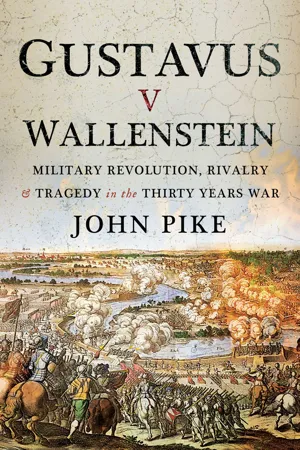
Explore the epic conflict and contrasting leadership styles of King Gustavus Adolphus of Sweden and Albrecht von Wallenstein, Duke of Friedland, two titanic figures in the Thirty Years War whose strategic brilliance and dramatic deaths shaped the course of modern warfare, analyzed in vivid detail by the author. The conflict, personal rivalry and contrast in personality, generalship and command, between the two iconic commanders in the Thirty Years War, King Gustavus Adolphus of Sweden for the Protestant powers, and Albrecht von Wallenstein, Duke of Friedland. More than just commanders at the tactical level they were statesmen, military organizers and strategists on a continental scale. Both commanders represented the 17th-century 'military revolution in action'. The writing is vivid, graphic and detailed, without overloading, and readers can feel 'involved' in the action, from strategic planning to battlefield tactics, and even the melee. Both generals are titanic figures come, and their respective deaths - Gustavus heroically in battle and Wallenstein, murdered with the Emperor's compliance – were dramatic highpoints in the long war. This is no hagiography, and the author analyses the contrasting reputations of two of the greatest military figures in modern history and analyses mistakes as well their triumphs. Both commanders' understanding of the role of the modern state and finance as vital factors in the military revolution and modern warfare. A major contrast was Gustavus's constant search for the tactical and strategic initiative compared to Wallenstein's caution and patience and development of counter-punch defensive tactics. Exceptional for the period, a young warrior like an 'Alexander', Gustavus excelled in inspired battlefield leadership even at huge risk. Despite his death at Lutzen in 1632, he and his steadfast chancellor Oxenstierna, had decisively defeated the Emperor's attempt to subjugate the Empire and introduce the Catholic counter-reformation. Gustavus contributed hugely to the ending of Habsburg supremacy while advancing new concepts in modern war. His death ushered in his acolytes including generals Baner, Saxe-Weimar and Torstensson. Gustavus or Wallenstein, the greater of the two? The reader must judge but Napoleon included Gustavus in his list of ten greats with Julius Caesar, Hannibal Barca, and Alexander the Great.
eBook - PDF
Gustavus v Wallenstein
Military Revolution, Rivalry and Tragedy in the Thirty Years War
- 562 pages
- English
- PDF
- Available on iOS & Android
eBook - PDF
About this book
Information
Subtopic
Early Modern HistoryIndex
HistoryTable of contents
- Cover
- Book Title
- Copyright
- Contents
- Introduction
- Chapter I A Time of Wars
- Chapter II Gustavus in Search of Security, Identity and Glory
- Chapter III Wallenstein at War on the Carpathian Frontier
- Plates
- Chapter IV Gustavus Invades Polish Livonia and Captures Riga
- Chapter V Danish Intervention – The Rise of Wallenstein
- Chapter VI Gustavus Fights for the Baltic
- Chapter VII The Edict and Dismissal of Wallenstein
- Chapter VIII Enter Gustavus and the Battle of Breitenfeld
- Chapter IX Gustavus Rampant and Wallenstein Recall
- Chapter X Gustavus v Wallenstein
- Chapter XI The Assassination of Wallenstein
- Chapter XII Gustavus and Wallenstein – an Assessment
- Chapter XIII Military Revolution and State Modernisation
- Acknowledgements
- Notes
- Bibliography
- Appendix Currencies and Conversions
- Index
- Back cover
Trusted by 375,005 students
Access to over 1.5 million titles for a fair monthly price.
Study more efficiently using our study tools.
Frequently asked questions
Yes, you can cancel anytime from the Subscription tab in your account settings on the Perlego website. Your subscription will stay active until the end of your current billing period. Learn how to cancel your subscription
No, books cannot be downloaded as external files, such as PDFs, for use outside of Perlego. However, you can download books within the Perlego app for offline reading on mobile or tablet. Learn how to download books offline
Perlego offers two plans: Essential and Complete
- Essential is ideal for learners and professionals who enjoy exploring a wide range of subjects. Access the Essential Library with 800,000+ trusted titles and best-sellers across business, personal growth, and the humanities. Includes unlimited reading time and Standard Read Aloud voice.
- Complete: Perfect for advanced learners and researchers needing full, unrestricted access. Unlock 1.5M+ books across hundreds of subjects, including academic and specialized titles. The Complete Plan also includes advanced features like Premium Read Aloud and Research Assistant.
We are an online textbook subscription service, where you can get access to an entire online library for less than the price of a single book per month. With over 1.5 million books across 990+ topics, we’ve got you covered! Learn about our mission
Look out for the read-aloud symbol on your next book to see if you can listen to it. The read-aloud tool reads text aloud for you, highlighting the text as it is being read. You can pause it, speed it up and slow it down. Learn more about Read Aloud
Yes! You can use the Perlego app on both iOS and Android devices to read anytime, anywhere — even offline. Perfect for commutes or when you’re on the go.
Please note we cannot support devices running on iOS 13 and Android 7 or earlier. Learn more about using the app
Please note we cannot support devices running on iOS 13 and Android 7 or earlier. Learn more about using the app
Yes, you can access Gustavus v Wallenstein by John Pike in PDF and/or ePUB format, as well as other popular books in History & Early Modern History. We have over 1.5 million books available in our catalogue for you to explore.