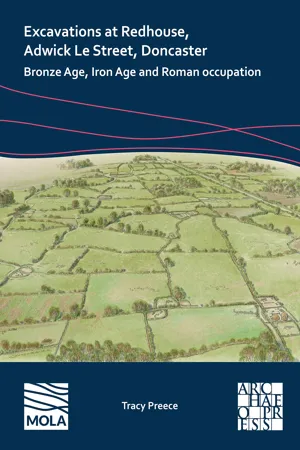
Excavations at Redhouse, Adwick Le Street, Doncaster
eBook - PDF

Excavations at Redhouse, Adwick Le Street, Doncaster

Bronze Age, Iron Age and Roman Occupation

  1. 166 pages
  2. English
  3. PDF
  4. Available on iOS & Android
eBook - PDF

Excavations at Redhouse, Adwick Le Street, Doncaster

Bronze Age, Iron Age and Roman Occupation

About this book

In the early Bronze Age, there was a single isolated burial monument defined by a ring ditch within which were six similarly shaped pits. One of these pits contained urned cremation burials, one pit contained an unurned cremation burial, two pits contained pottery vessels and two pits did not contain human remains or artefacts.

The vast majority of the archaeological evidence was associated with enclosures and fields systems that were probably established during the middle to late Iron Age period and were developed and expanded upon in the Roman period, being utilised until the early 4th century. At least two of the enclosures were established during the Iron Age and a further seven enclosures were created during the Roman period, with the earlier enclosures being incorporated. These enclosures and field ditches were part of an extensive landscape across this area, where a vast array of cropmarks have been plotted, making the Redhouse site just one of many in the landscape. Part of the Roman Road from Lincoln to York, known locally as the Roman Ridge, extended across the eastern part of the area.

Enclosures were utilised for both domestic and other functions such as crop processing, stock management and smithing. Features found included a crouched inhumation within a pit which was radiocarbon dated to the middle Iron Age. Several Roman coins including three counterfeits were recovered during excavations. Of note were fragments of coin moulds from one of the Roman enclosure ditches, which makes this one of only about 40 sites that have produced evidence for this activity.

Frequently asked questions

Yes, you can cancel anytime from the Subscription tab in your account settings on the Perlego website. Your subscription will stay active until the end of your current billing period. Learn how to cancel your subscription.
At the moment all of our mobile-responsive ePub books are available to download via the app. Most of our PDFs are also available to download and we're working on making the final remaining ones downloadable now. Learn more here.
Perlego offers two plans: Essential and Complete
  • Essential is ideal for learners and professionals who enjoy exploring a wide range of subjects. Access the Essential Library with 800,000+ trusted titles and best-sellers across business, personal growth, and the humanities. Includes unlimited reading time and Standard Read Aloud voice.
  • Complete: Perfect for advanced learners and researchers needing full, unrestricted access. Unlock 1.4M+ books across hundreds of subjects, including academic and specialized titles. The Complete Plan also includes advanced features like Premium Read Aloud and Research Assistant.
Both plans are available with monthly, semester, or annual billing cycles.
We are an online textbook subscription service, where you can get access to an entire online library for less than the price of a single book per month. With over 1 million books across 1000+ topics, we’ve got you covered! Learn more here.
Look out for the read-aloud symbol on your next book to see if you can listen to it. The read-aloud tool reads text aloud for you, highlighting the text as it is being read. You can pause it, speed it up and slow it down. Learn more here.
Yes! You can use the Perlego app on both iOS or Android devices to read anytime, anywhere — even offline. Perfect for commutes or when you’re on the go.
Please note we cannot support devices running on iOS 13 and Android 7 or earlier. Learn more about using the app.
Yes, you can access Excavations at Redhouse, Adwick Le Street, Doncaster by Tracy Preece in PDF and/or ePUB format, as well as other popular books in Social Sciences & Archaeology. We have over one million books available in our catalogue for you to explore.

Table of contents

  1. Cover
  2. Title Page
  3. Copyright page
  4. Contents Page
  5. List of Figures
  6. List of Tables
  7. Contributors
  8. Acknowledgements
  9. Chapter 1
  10. Introduction
  11. Chapter 2
  12. Neolithic and early Bronze Age
  13. Chapter 3
  14. Iron Age and Roman
  15. Chapter 4
  16. Discussion
  17. Bibliography
  18. Back Cover