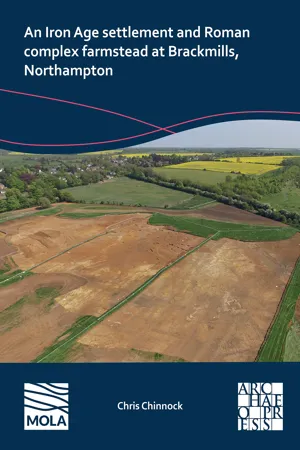
MOLA (Museum of London Archaeology) undertook archaeological excavations at Brackmills, Northampton, investigatng part of a large Iron Age settlement and Roman complex farmstead. The remains were very well preserved having, in places, been shielded from later truncaton by colluvial deposits. Earlier remains included a late Bronze Age/early Iron Age pit alignment.
The main focus of occupation spanned the middle Iron Age to the late 4th century/early 5th century AD. The initial late middle Iron Age enclosed farmstead was defined by a series of enclosures and boundary features. From the late Iron Age the core of the settlement shifted and the range of activity increased dramatically, both in complexity and density through the 1st and 2nd centuries AD. The pottery assemblage associated with the beginning of this development is dominated by utilitarian jars with no clear evidence of higher status activity. Two well preserved pottery kilns date from this period, adding to our understanding of local pottery traditions. Funerary evidence for this period was limited to two late Iron Age/early Roman crouched inhumations, and a small assemblage of disarticulated human bone.
By the second century the settlement had developed further, and a well-constructed road surface had been laid, leading to the stone roundhouses at the core of the settlement. The re-establishment or expansion of the farmstead with stone rectangular buildings in the late 3rd to 4th century AD marks a clear shift in the status of the site. Industrial remains included a drying oven. Of note for a rural site were 17 inhumation burials and a single cremation burial. Following the decline of the settlement, there was only a short reoccupation when there was a single sunken featured building. Later the site became part of an open field system in the medieval period.