Offering a re-reading of Erasmus's works, this book shows that emotion and affectivity were central to his writings. It argues that Erasmus's conception of emotion was highly complex and richly diverse by tracing how the Dutch humanist writes about emotion not only from different perspectives-theological, philosophical, literary, rhetorical, medical-but also in different genres. In doing so, this book suggests, Erasmus provided a distinctive, if not unique, Christian humanist emotional style.
Demonstrating that Erasmus consulted multiple intellectual traditions and previous works in his thoughts on affectivity, The Renaissance of Feeling sheds light on how understanding emotions in late medieval and early modern Europe was a multi-disciplinary affair for humanist scholars. It argues that the rediscovery and proliferation ancient texts during the so-called renaissance resulted in shifting perspectives on how emotions were described and understood, and on their significance for Christian thought and practice. The book shows how the very availability of source material, coupled with humanists' eagerness to engage with multiple intellectual traditions gave rise to new understandings of feeling in the 16th century.
Essary shows how Erasmus provides the clearest example of such an intellectual inheritance by examining his writings about emotion across much of his vast corpus, including literary and rhetorical works, theological treatises, textual commentaries, religious disputations, and letters. Considering the rich and diverse ways that Erasmus wrote about emotions and affectivity, this book provides a new lens to study his works and sheds light on how emotions were understood in early modern Europe.
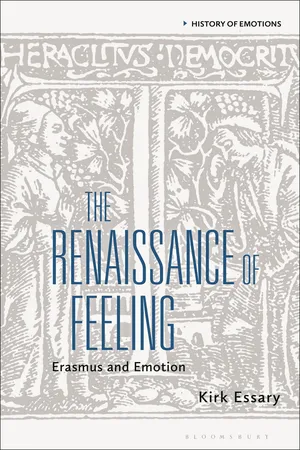
- 240 pages
- English
- ePUB (mobile friendly)
- Available on iOS & Android
eBook - ePub
About this book
Information
Table of contents
- Cover
- Half-Title
- Series
- Title
- Contents
- Acknowledgments
- Abbreviations of Works Frequently Cited
- Chapter 1 INTRODUCTION: ERASMUS AND THE INTELLECTUAL HISTORY OF EMOTION
- Chapter 2 COMIC AND TRAGIC FEELINGS: THE EMOTIONS OF CLASSICAL LITERATURE
- Chapter 3 BIND THIS PROTEUS: TRANSFORMING THE ANCIENT PHILOSOPHY OF FEELING
- Chapter 4 BIBLICAL EMOTIONS I: AFFECTIVE THEOLOGY AND THE NEW TESTAMENT
- Chapter 5 BIBLICAL EMOTIONS II: STOMACHS, STRINGS, AND SYNECDOCHE IN THE PSALMS
- Chapter 6 PASSIONATE PREACHING: AFFECTIVE RHETORIC IN THE PULPIT
- Chapter 7 EPISTOLARY EMOTIONS: AUTHENTICITY, EXILE, AND CONSOLATION
- Chapter 8 “ALWAYS BREATHING TRAGEDY”: LUTHER AND THE VIOLENT EMOTIONS
- EPILOGUE: “PHILISTINES FOAMING AT THE MOUTH”
- Bibliography
- Index
- Copyright
Trusted by 375,005 students
Access to over 1.5 million titles for a fair monthly price.
Study more efficiently using our study tools.
Frequently asked questions
Yes, you can cancel anytime from the Subscription tab in your account settings on the Perlego website. Your subscription will stay active until the end of your current billing period. Learn how to cancel your subscription
No, books cannot be downloaded as external files, such as PDFs, for use outside of Perlego. However, you can download books within the Perlego app for offline reading on mobile or tablet. Learn how to download books offline
Perlego offers two plans: Essential and Complete
- Essential is ideal for learners and professionals who enjoy exploring a wide range of subjects. Access the Essential Library with 800,000+ trusted titles and best-sellers across business, personal growth, and the humanities. Includes unlimited reading time and Standard Read Aloud voice.
- Complete: Perfect for advanced learners and researchers needing full, unrestricted access. Unlock 1.5M+ books across hundreds of subjects, including academic and specialized titles. The Complete Plan also includes advanced features like Premium Read Aloud and Research Assistant.
We are an online textbook subscription service, where you can get access to an entire online library for less than the price of a single book per month. With over 1.5 million books across 990+ topics, we’ve got you covered! Learn about our mission
Look out for the read-aloud symbol on your next book to see if you can listen to it. The read-aloud tool reads text aloud for you, highlighting the text as it is being read. You can pause it, speed it up and slow it down. Learn more about Read Aloud
Yes! You can use the Perlego app on both iOS and Android devices to read anytime, anywhere — even offline. Perfect for commutes or when you’re on the go.
Please note we cannot support devices running on iOS 13 and Android 7 or earlier. Learn more about using the app
Please note we cannot support devices running on iOS 13 and Android 7 or earlier. Learn more about using the app
Yes, you can access The Renaissance of Feeling by Kirk Essary in PDF and/or ePUB format, as well as other popular books in History & European Renaissance History. We have over 1.5 million books available in our catalogue for you to explore.