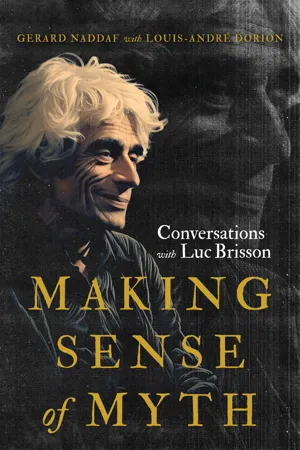
To most, myths are merely fantastic stories. But for Luc Brisson, one of the great living Plato scholars, myth is a key factor in what it means to be human – a condition of life for all. Essential and inescapable, myth offers a guide for living, forming the core of belonging and group identity.
In 1999 Quebec classicist Louis-André Dorion published a series of French conversations with Brisson on the idea of myth. In Making Sense of Myth Gerard Naddaf offers an extended and updated English translation of these conversations, as well as a new set of discussions between himself and Brisson. Beginning with Brisson's childhood in the village of Saint-Esprit, Quebec, through his education as a gifted child in minor seminaries starting at age eleven, and continuing with his years in Paris, first as a graduate student and later at the Centre national de la recherche scientifique (CNRS), Brisson tells the story of his escape from an all-encompassing myth – the one promulgated by the Roman Catholic Church. The philosopher situates Quebec society as inseparable from the history of the Catholic Church in Quebec, and argues that this correlation offers a perfect paradigm of myth and mythmaking. Naddaf’s introduction and afterword contextualize the conversations by discussing Brisson’s and Plato’s understanding of the origin and meaning of myth, elaborating on the role of myth in anthropogeny, in the creation of selfhood, and in multiculturalism.
Making Sense of Myth promises both a philosophy of myth and a philosophy of life, one inspired by Brisson’s lifelong engagement with the great Western philosopher Plato.
- 328 pages
- English
- ePUB (mobile friendly)
- Available on iOS & Android
eBook - ePub
About this book
Information
Publisher
McGill-Queen's University PressYear
2024Print ISBN
9780228020714
9780228020707
eBook ISBN
9780228020738
Topic
PhilosophySubtopic
PhilosophersTable of contents
- Cover
- Copyright
- Contents
- Acknowledgments
- Introduction
- Part One
- Part Two
- Part Three
- Part Four
- Afterword
- Notes
- References
- Index
Trusted by 375,005 students
Access to over 1.5 million titles for a fair monthly price.
Study more efficiently using our study tools.
Frequently asked questions
Yes, you can cancel anytime from the Subscription tab in your account settings on the Perlego website. Your subscription will stay active until the end of your current billing period. Learn how to cancel your subscription
No, books cannot be downloaded as external files, such as PDFs, for use outside of Perlego. However, you can download books within the Perlego app for offline reading on mobile or tablet. Learn how to download books offline
Perlego offers two plans: Essential and Complete
- Essential is ideal for learners and professionals who enjoy exploring a wide range of subjects. Access the Essential Library with 800,000+ trusted titles and best-sellers across business, personal growth, and the humanities. Includes unlimited reading time and Standard Read Aloud voice.
- Complete: Perfect for advanced learners and researchers needing full, unrestricted access. Unlock 1.5M+ books across hundreds of subjects, including academic and specialized titles. The Complete Plan also includes advanced features like Premium Read Aloud and Research Assistant.
We are an online textbook subscription service, where you can get access to an entire online library for less than the price of a single book per month. With over 1.5 million books across 990+ topics, we’ve got you covered! Learn about our mission
Look out for the read-aloud symbol on your next book to see if you can listen to it. The read-aloud tool reads text aloud for you, highlighting the text as it is being read. You can pause it, speed it up and slow it down. Learn more about Read Aloud
Yes! You can use the Perlego app on both iOS and Android devices to read anytime, anywhere — even offline. Perfect for commutes or when you’re on the go.
Please note we cannot support devices running on iOS 13 and Android 7 or earlier. Learn more about using the app
Please note we cannot support devices running on iOS 13 and Android 7 or earlier. Learn more about using the app
Yes, you can access Making Sense of Myth by Gerard Naddaf,Louis-André Dorion in PDF and/or ePUB format, as well as other popular books in Philosophy & Philosophers. We have over 1.5 million books available in our catalogue for you to explore.