Explores how Black New Englanders maintained a sense of belonging among their kin in the face of slavery
As winter turned to spring in the year 1699, Sebastian and Jane embarked on a campaign of persuasion. The two wished to marry, and they sought the backing of their community in Boston. Nothing, however, could induce Jane's enslaver to consent. Only after her death did Sebastian and Jane manage to wed, forming a long-lasting union even though husband and wife were not always able to live in the same household.
New England is often considered a cradle of liberty in American history, but this snippet of Jane and Sebastian's story reminds us that it was also a cradle of slavery. From the earliest years of colonization, New Englanders bought and sold people, most of whom were of African descent. In Belonging, Gloria McCahon Whiting tells the region's early history from the perspective of the people, like Jane and Sebastian, who belonged to others and who struggled to maintain a sense of belonging among their kin. Through a series of meticulously reconstructed family narratives, Whiting traces the contours of enslaved people's intimate lives in early New England, where they often lived with those who bound them but apart from kin. Enslaved spouses rarely were able to cohabit; fathers and their offspring routinely were separated by inheritance practices; children could be removed from their mothers at an enslaver's whim; and people in bondage had only partial control of their movement through the region, which made more difficult the task of maintaining distant relationships.
But Belonging does more than lay bare the obstacles to family stability for those in bondage. Whiting also charts Afro-New Englanders' persistent demands for intimacy throughout the century and a half stretching from New England's founding to the American Revolution. And she shows how the work of making and maintaining relationships influenced the region's law, religion, society, and politics. Ultimately, the actions taken by people in bondage to fortify their families played a pivotal role in bringing about the collapse of slavery in New England's most populous state, Massachusetts.
eBook - ePub
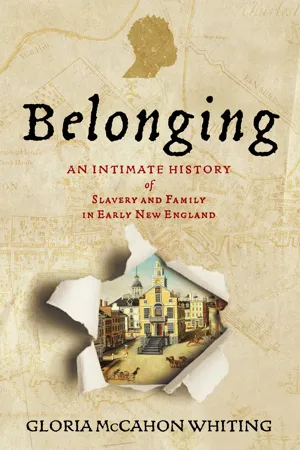
Belonging
An Intimate History of Slavery and Family in Early New England
- 384 pages
- English
- ePUB (mobile friendly)
- Available on iOS & Android
eBook - ePub
About this book
Information
Subtopic
African American HistoryIndex
HistoryTable of contents
- Cover
- Series Page
- Title Page
- Copyright
- Dedication
- Contents
- List of Illustrations
- On Names and More
- Introduction
- Chapter 1. Dorcas and Her Kin: Slavery, Family, and the Law in the Seventeenth Century
- Chapter 2. Sebastian, Jane Lake, and Their Children: Marriage, Gender, and Power in Slavery
- Chapter 3. Sue Black and Her Sons: Childbirth, Child-Rearing, and Childhood in Bondage
- Chapter 4. The Bedunahs: Sex and Family Across the Color Line
- Chapter 5. Mark, Phillis, and Phoebe: Community, Kin, and Other Intimacies
- Chapter 6. The Vassalls: Black Families and the End of Slavery in Revolutionary Massachusetts
- Conclusion
- Note on Sources
- Note on Images
- Abbreviations
- Notes
- Index
- Acknowledgments
Trusted by 375,005 students
Access to over 1.5 million titles for a fair monthly price.
Study more efficiently using our study tools.
Frequently asked questions
Yes, you can cancel anytime from the Subscription tab in your account settings on the Perlego website. Your subscription will stay active until the end of your current billing period. Learn how to cancel your subscription
No, books cannot be downloaded as external files, such as PDFs, for use outside of Perlego. However, you can download books within the Perlego app for offline reading on mobile or tablet. Learn how to download books offline
Perlego offers two plans: Essential and Complete
- Essential is ideal for learners and professionals who enjoy exploring a wide range of subjects. Access the Essential Library with 800,000+ trusted titles and best-sellers across business, personal growth, and the humanities. Includes unlimited reading time and Standard Read Aloud voice.
- Complete: Perfect for advanced learners and researchers needing full, unrestricted access. Unlock 1.5M+ books across hundreds of subjects, including academic and specialized titles. The Complete Plan also includes advanced features like Premium Read Aloud and Research Assistant.
We are an online textbook subscription service, where you can get access to an entire online library for less than the price of a single book per month. With over 1.5 million books across 990+ topics, we’ve got you covered! Learn about our mission
Look out for the read-aloud symbol on your next book to see if you can listen to it. The read-aloud tool reads text aloud for you, highlighting the text as it is being read. You can pause it, speed it up and slow it down. Learn more about Read Aloud
Yes! You can use the Perlego app on both iOS and Android devices to read anytime, anywhere — even offline. Perfect for commutes or when you’re on the go.
Please note we cannot support devices running on iOS 13 and Android 7 or earlier. Learn more about using the app
Please note we cannot support devices running on iOS 13 and Android 7 or earlier. Learn more about using the app
Yes, you can access Belonging by Gloria McCahon Whiting in PDF and/or ePUB format, as well as other popular books in History & African American History. We have over 1.5 million books available in our catalogue for you to explore.