A trailblazing anthropologist and an indigenous Amazonian healer explore the convergence of science and shamanism
"The dose makes the poison," says an old adage, reminding us that substances have the potential to heal or to harm, depending on their use. Although Western medicine treats tobacco as a harmful addictive drug, it is considered medicinal by indigenous people of the Amazon rainforest. In its unadulterated form, it holds a central place in their repertoire of traditional medicines. Along with ayahuasca, tobacco forms a part of treatments designed to heal the body, stimulate the mind, and inspire the soul with visions. In Plant Teachers, anthropologist Jeremy Narby and traditional healer Rafael Chanchari Pizuri hold a cross-cultural dialogue that explores the similarities between ayahuasca and tobacco, the role of these plants in indigenous cultures, and the hidden truths they reveal about nature. Juxtaposing and synthesizing two worldviews, Plant Teachers invites readers on a wide-ranging journey through anthropology, botany, and biochemistry, while raising tantalizing questions about the relationship between science and other ways of knowing.
eBook - ePub
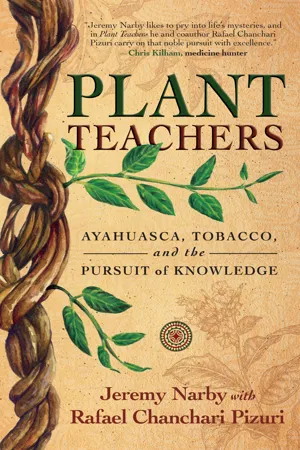
Plant Teachers
Ayahuasca, Tobacco, and the Pursuit of Knowledge
- 152 pages
- English
- ePUB (mobile friendly)
- Available on iOS & Android
eBook - ePub
About this book
Information
Print ISBN
9781608684021
Subtopic
Native American StudiesTable of contents
- Cover
- Title Page
- Copyright
- Contents
- Foreword
- Introduction
- Chapter 1: Medicine and Malice: Tobacco from an Indigenous Perspective
- Chapter 2: Remedy and Poison: The Science of Tobacco
- Chapter 3: Two-Sided Purge: Ayahuasca from an Indigenous Perspective
- Chapter 4: Discombobulating Therapeutic Cocktail: The Science of Ayahuasca
- Conclusion
- Appendix: Vape, Snuff, Rapé, and Snus
- Acknowledgments
- Endnotes
- Bibliography
- Index
- About the Authors
Trusted by 375,005 students
Access to over 1.5 million titles for a fair monthly price.
Study more efficiently using our study tools.
Frequently asked questions
Yes, you can cancel anytime from the Subscription tab in your account settings on the Perlego website. Your subscription will stay active until the end of your current billing period. Learn how to cancel your subscription
No, books cannot be downloaded as external files, such as PDFs, for use outside of Perlego. However, you can download books within the Perlego app for offline reading on mobile or tablet. Learn how to download books offline
Perlego offers two plans: Essential and Complete
- Essential is ideal for learners and professionals who enjoy exploring a wide range of subjects. Access the Essential Library with 800,000+ trusted titles and best-sellers across business, personal growth, and the humanities. Includes unlimited reading time and Standard Read Aloud voice.
- Complete: Perfect for advanced learners and researchers needing full, unrestricted access. Unlock 1.5M+ books across hundreds of subjects, including academic and specialized titles. The Complete Plan also includes advanced features like Premium Read Aloud and Research Assistant.
We are an online textbook subscription service, where you can get access to an entire online library for less than the price of a single book per month. With over 1.5 million books across 990+ topics, we’ve got you covered! Learn about our mission
Look out for the read-aloud symbol on your next book to see if you can listen to it. The read-aloud tool reads text aloud for you, highlighting the text as it is being read. You can pause it, speed it up and slow it down. Learn more about Read Aloud
Yes! You can use the Perlego app on both iOS and Android devices to read anytime, anywhere — even offline. Perfect for commutes or when you’re on the go.
Please note we cannot support devices running on iOS 13 and Android 7 or earlier. Learn more about using the app
Please note we cannot support devices running on iOS 13 and Android 7 or earlier. Learn more about using the app
Yes, you can access Plant Teachers by Jeremy Narby,Rafael Chanchari Pizuri in PDF and/or ePUB format. We have over 1.5 million books available in our catalogue for you to explore.