- 292 pages
- English
- PDF
- Available on iOS & Android
About this book
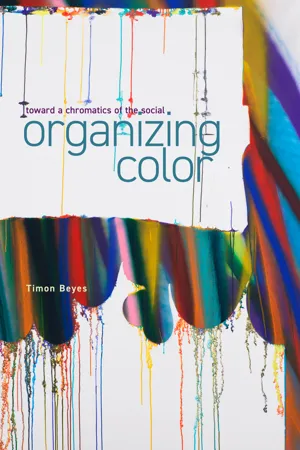
We live in a world that is saturated with color, but how should we make sense of color's force and capacities? This book develops a theory of color as fundamental medium of the social.
Constructed as a montage of scenes from the past two hundred years, Organizing Color demonstrates how the interests of capital, management, governance, science, and the arts have wrestled with color's allure and flux. Beyes takes readers from Goethe's chocolate experiments in search of chromatic transformation to nineteenth-century Scottish cotton mills designed to modulate workers' moods and productivity, from the colonial production of indigo in India to globalized categories of skin colorism and their disavowal. Tracing the consumption, control and excess of industrial and digital color, other chapters stage encounters with the literary chromatics of Pynchon's Gravity's Rainbow processing the machinery of the chemical industries, the red of political revolt in Godard's films, and the blur of education and critique in Steyerl's Adorno's Grey.
Contributing to a more general reconsideration of aesthetic capitalism and the role of sensory media, this book seeks to pioneer a theory of social organization—a "chromatics of organizing"—that is attuned to the protean and world-making capacity of color.
Frequently asked questions
- Essential is ideal for learners and professionals who enjoy exploring a wide range of subjects. Access the Essential Library with 800,000+ trusted titles and best-sellers across business, personal growth, and the humanities. Includes unlimited reading time and Standard Read Aloud voice.
- Complete: Perfect for advanced learners and researchers needing full, unrestricted access. Unlock 1.4M+ books across hundreds of subjects, including academic and specialized titles. The Complete Plan also includes advanced features like Premium Read Aloud and Research Assistant.
Please note we cannot support devices running on iOS 13 and Android 7 or earlier. Learn more about using the app.
Information
Table of contents
- Cover
- Title Page
- Copyright
- Contents
- 1. Something Winged: Color as Organizational Force
- 2. Weimar, ca. 1800: Cooking Chocolate
- 3. New Lanark, 1816: Working the Silent Monitor
- 4. Lower Bengal, 1859: The Coke of Empire
- 5. Berlin, 1924: Consuming the Color Chart
- 6. The Zone, 1945: Unleashing the Synthetic Rainbow
- 7. Paris, 1967: The Revolution Will Be Colorized
- 8. Houston, 1971: Two Kinds of Colorism
- 9. Cologne, 2007: The Distribution of the Insensible
- 10. Broken Tones: Toward a Chromatics of the Social
- Acknowledgments
- Notes
- Works Cited
- Index
- Back Cover