Employing the idea of interculturality to study Middle Eastern adaptations of Greek tragedy from the turn of 20th century until the present day, this book first explores the earlier phase of the development of Greek classical reception in Middle Eastern theatre. It then moves to focus on modern Arabic, Persian and Turkish adaptations of Greek tragedy both in the early post-colonial and contemporary periods in the MENA and in Europe. Case by case, this book examines how the classical sources are reworked and adapted, as well as how they engage with interculturality, hybridisation and the circulation of aesthetics and models. At the same time, it explores the implications and consequences of expressing socio-political concerns through classical Greek sources.
While Muslim thinkers and translators introduced Greek philosophy – in particular Aristotle's Poetics – to the West in the Middle Ages, adaptations of Greek tragedies only appeared in the MENA region at the very beginning of the 20th century. For this reason, the development of Greek tragedy in the Middle East is difficult to disentangle from colonialism and cultural imperialism. Encompassing language differences and offering for the first time a broad approach on the Middle-Eastern reception of Greek tragedy, this book produces a renewed focus on a fascinating aspect of the classical tradition.
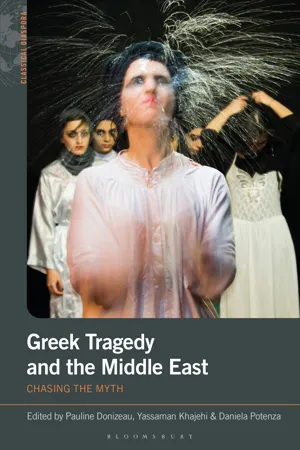
eBook - ePub
Greek Tragedy and the Middle East
Chasing the Myth
- 228 pages
- English
- ePUB (mobile friendly)
- Available on iOS & Android
eBook - ePub
Greek Tragedy and the Middle East
Chasing the Myth
About this book
Information
Table of contents
- Cover
- Half-Title Page
- Series Page
- Title Page
- Contents
- List of Illustrations
- List of Contributors
- Foreword
- Introduction
- Part One Adaptations and Translations of Greek Tragedy in a Colonial Context: An Historical Perspective
- 1 Tragic Ways, Tragic Voices: Translating Greek Tragedy into Arabic in the Wake of the Nahḍa
- 2 Oedipus of Thebes on Arab Stages
- 3 From Ancient Greek Theatre to Turkish Theatre and Back: State of the Art
- Part Two The Model as Diversion: A Tool to Tackle Political Issues on the Contemporary Stage
- 4 Brave Women in a Mad World: Euripides and the State of Exception in Arab Theatre
- 5 So Many Medeas! Medea in Iran and Lebanon since 2015
- 6 Antigone in Iran: Towards a Political Subject of Resistance
- 7 When Iraqi Theatre Met the World Again: Haythem Abderrazak and His Looking for Oresteia
- Part Three Greek Tragedy, a Shared Heritage?
- 8 Ambivalence of Interpretation between Israel and France in Hanoch Levin’s Theatre Tragic Materials
- 9 Sophocles’ Antigone by French Director Adel Hakim (2011)Using Greek Tragedy to Pay Tribute to Palestinian Resistance
- 10 Looking at Iraq from Afar: Two Oresteia on European Stages
- 11 Two Oresteia on European Stages: A Moroccan Tragedy
- Afterword
- Index of Subjects
- Index of Names
- Index of Places
- Copyright
Trusted by 375,005 students
Access to over 1.5 million titles for a fair monthly price.
Study more efficiently using our study tools.
Frequently asked questions
Yes, you can cancel anytime from the Subscription tab in your account settings on the Perlego website. Your subscription will stay active until the end of your current billing period. Learn how to cancel your subscription
No, books cannot be downloaded as external files, such as PDFs, for use outside of Perlego. However, you can download books within the Perlego app for offline reading on mobile or tablet. Learn how to download books offline
Perlego offers two plans: Essential and Complete
- Essential is ideal for learners and professionals who enjoy exploring a wide range of subjects. Access the Essential Library with 800,000+ trusted titles and best-sellers across business, personal growth, and the humanities. Includes unlimited reading time and Standard Read Aloud voice.
- Complete: Perfect for advanced learners and researchers needing full, unrestricted access. Unlock 1.5M+ books across hundreds of subjects, including academic and specialized titles. The Complete Plan also includes advanced features like Premium Read Aloud and Research Assistant.
We are an online textbook subscription service, where you can get access to an entire online library for less than the price of a single book per month. With over 1.5 million books across 990+ topics, we’ve got you covered! Learn about our mission
Look out for the read-aloud symbol on your next book to see if you can listen to it. The read-aloud tool reads text aloud for you, highlighting the text as it is being read. You can pause it, speed it up and slow it down. Learn more about Read Aloud
Yes! You can use the Perlego app on both iOS and Android devices to read anytime, anywhere — even offline. Perfect for commutes or when you’re on the go.
Please note we cannot support devices running on iOS 13 and Android 7 or earlier. Learn more about using the app
Please note we cannot support devices running on iOS 13 and Android 7 or earlier. Learn more about using the app
Yes, you can access Greek Tragedy and the Middle East by Pauline Donizeau, Yassaman Khajehi, Daniela Potenza, Pauline Donizeau,Yassaman Khajehi,Daniela Potenza in PDF and/or ePUB format, as well as other popular books in Literature & Ancient & Classical Drama. We have over 1.5 million books available in our catalogue for you to explore.