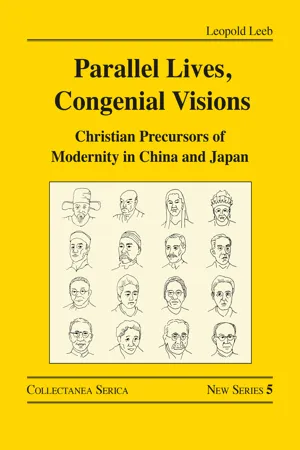
Parallel Lives, Congenial Visions
eBook - ePub

Parallel Lives, Congenial Visions

Christian Precursors of Modernity in China and Japan

  1. 294 pages
  2. English
  3. ePUB (mobile friendly)
  4. Available on iOS & Android
eBook - ePub

Parallel Lives, Congenial Visions

Christian Precursors of Modernity in China and Japan

About this book

This book introduces the history of cultural exchanges between East Asia and the West through comparative biographical sketches of sixty personalities from China and Japan. These sketches illustrate how both countries, starting from a shared cultural heritage in script and Confucian, Buddhist, and Daoist worldviews, took rather different approaches in their encounters with the European world since the 16th to 17th centuries. In particular in the 19th century under external and internal pressure, both nations strove to modernize their societies by introducing technology and new ideas from the Western world, turning them into political rivals and even enemies. Thus, these biographical sketches also shed some light on the general dynamics of cross-cultural interactions between China, Japan, and the West up to the early 20th century.

The Chinese and Japanese men and women presented in this book are outstanding personalities who tried to open up the road to international relationships, pioneers in their respective domains who introduced Western culture to their nations, precursors who strove for modernization, e.g., in the fields of translation, education, medicine, media, and social welfare. They testify to individual agency in these cross-cultural exchanges. Many of those who tried to be "cultural bridge-builders" since the 16th century were Christians, simply because the missionaries, who worked hard to learn the native languages of China and Japan, were the first to introduce new cultural elements to these countries. The universal scope and vision of the Christian faith enabled both missionaries and native believers to overcome narrow nationalism or xenophobia and turned them into cross-cultural mediators.

Frequently asked questions

Yes, you can cancel anytime from the Subscription tab in your account settings on the Perlego website. Your subscription will stay active until the end of your current billing period. Learn how to cancel your subscription.
No, books cannot be downloaded as external files, such as PDFs, for use outside of Perlego. However, you can download books within the Perlego app for offline reading on mobile or tablet. Learn more here.
Perlego offers two plans: Essential and Complete
  • Essential is ideal for learners and professionals who enjoy exploring a wide range of subjects. Access the Essential Library with 800,000+ trusted titles and best-sellers across business, personal growth, and the humanities. Includes unlimited reading time and Standard Read Aloud voice.
  • Complete: Perfect for advanced learners and researchers needing full, unrestricted access. Unlock 1.4M+ books across hundreds of subjects, including academic and specialized titles. The Complete Plan also includes advanced features like Premium Read Aloud and Research Assistant.
Both plans are available with monthly, semester, or annual billing cycles.
We are an online textbook subscription service, where you can get access to an entire online library for less than the price of a single book per month. With over 1 million books across 1000+ topics, we’ve got you covered! Learn more here.
Look out for the read-aloud symbol on your next book to see if you can listen to it. The read-aloud tool reads text aloud for you, highlighting the text as it is being read. You can pause it, speed it up and slow it down. Learn more here.
Yes! You can use the Perlego app on both iOS or Android devices to read anytime, anywhere β€” even offline. Perfect for commutes or when you’re on the go.
Please note we cannot support devices running on iOS 13 and Android 7 or earlier. Learn more about using the app.
Yes, you can access Parallel Lives, Congenial Visions by Leopold Leeb in PDF and/or ePUB format, as well as other popular books in History & Christianity. We have over one million books available in our catalogue for you to explore.

Information

Publisher
Routledge
Year
2024
Print ISBN
9781032621982
eBook ISBN
9781003858218
Topic
History
Subtopic
Christianity
Index
History

Table of contents

  1. Cover Page
  2. Half Title page
  3. Title Page
  4. Copyright Page
  5. Contents
  6. Preface by He Guanghu
  7. Preface by Muraoka Takamitsu
  8. Preface by the Author
  9. Introduction
  10. Chapter One: The Trailblazers' Guides Anjirō (ca. 1520–1565) and Zhong Mingren (1562–1621)
  11. Chapter Two: The First Translators of European Texts: Yohoken (ca. 1510–1596) and Xu Ruohan (ca. 1670–1740)
  12. Chapter Three: Noble Promoters of Military Reforms: Otomo Sorin (1530–1587) And Xu Guangqi (1562–1633)
  13. Chapter Four: β€œGrace” and β€œBrilliance”: Hosokawa Garasha (1563–1600) and Candida Xu (1607–1680)
  14. Chapter Five: Pioneers of Comparative Philosophy: Fukansai (1565–1621) and Yang Tingyun (ca. 1557–1628)
  15. Chapter Six: The First Native Priests: Kimura (1565–1622) and Luo Wenzao (1617–1691)
  16. Chapter Seven: The First Travelers to Europe: Itō Mancio (1569–1612) and Zheng Manuo (1633–1673)
  17. Chapter Eight: Precursors of the Internationalization of the Script: Constantino Dourado (1567–1620) and Wang Zheng (1571–1644)
  18. Chapter Nine: The First Editors of Bilingual Dictionaries: Martinho Hara (1568–1629) and Huang Risheng (1679–1716)
  19. Chapter Ten: the Earliest Celebrities in Europe: Hasekura Tsunenaga (1571–1622) and Shen Fuzong (ca. 1658–1692)
  20. Chapter Eleven: Western Art in the East: Jacobus Niva (Ni Yagu, 1579–1638) and You Wenhui (1575–1633)
  21. Chapter Twelve: Hope of the Suppressed: Amakusa Shirō (1622–1638) and Maria Wang (ca. 1855–1900)
  22. Chapter Thirteen: Interrogation of a Messenger from the West: Arai Hakuseki (1657–1725) and Kangxi (r. 1662–1722)
  23. Chapter Fourteen: Early Students of Western Medicine: Gao Leisi (1732–1795), Yang Dewang (1733–1798), and Sugita Genpaku (1733–1817)
  24. Chapter Fifteen: The First Teachers of Western Languages: Ogata Kōan (1810–1863) and Xue Madou (ca. 1780–1860)
  25. Chapter Sixteen: Organizers of Modern Media: Fukuzawa Yukichi (1835–1901) and Ying Lianzhi (1866–1926)
  26. Chapter Seventeen: Creators of Universities: Yan Yongjing (1838–1898) and Niijima Jō (1843–1890)
  27. Chapter Eighteen: Entrepreneurs and Philanthropists: Shibusawa Eiichi (1840–1931) and Lu Bohong (1875–1937)
  28. Chapter Nineteen: The First Female Physicians: Ogino Ginko (1851–1913) and Jin Yamei (1864–1934)
  29. Chapter Twenty: Pioneers of Women's Education: Tsuda Umeko (1864–1929) and Zeng Baosun (1893–1978)
  30. Chapter Twenty-One: Faith on the Way to Inculturation: Uemura Masahisa (1858–1925) and Zhao Zichen (T.C. Chao, 1888–1979)
  31. Chapter Twenty-Two: Fathers of Constitutional Law: Ume Kenjirō (1860–1910) and Wu Jingxiong (1899–1986)
  32. Chapter Twenty-Three: Creators of an Image of the East: Nitobe Inazō (1862–1933) and Gu Hongming (1857–1928)
  33. Chapter Twenty-Four: Independent Prophets: Uchimura Kanzō (1861–1930) and Wang Mingdao (1900–1991)
  34. Chapter Twenty-Five: Pioneers in the Study of History: Saeki Yoshirō (1871–1965) and Chen Yuan (1880–1971)
  35. Chapter Twenty-Six: The First Students of Classical Hebrew: Kotsuji Setsuzō (1899–1973) and Li Rongfang (1887–1965)
  36. Chapter Twenty-Seven: Indigenization of Christian Art: Chen Yuandu (1903–1967) and Watanabe Sadao (1913–1996)
  37. Chapter Twenty-Eight: A Life for the Poor: Wu Yongbo (1916–2002) and Kitahara Satoko (1929–1958)
  38. Conclusion: Two Nations on the Way to Modernity
  39. Bibliography
  40. Table 1: History of the Churches in China and Japan
  41. Table 2: Pioneers in China and Japan
  42. Index and Glossary