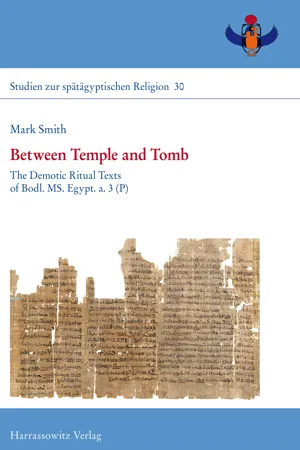
The ancient Egyptians believed that rites performed for Osiris, the god of the dead, played a critical role in maintaining Egypt's well-being and prosperity. Not only did they ensure the renewed fertility of the country's arable land, they also guaranteed the political and social cohesion of the Egyptian state. However, it was not only at the national level, but at the individual level as well, that the Egyptians deemed such rites to be beneficial. Ritual texts intended to restore Osiris to life, suitably adapted, could also be recited for deceased individuals. Thus they could benefit from them in the same way that Osiris did. In the Graeco-Roman Period, adapted ritual texts of this sort were employed alongside texts originally composed for use in the funerary cult of ordinary deceased people. A number of ritual texts which are first attested in the private sphere subsequently appear in the temple sphere as well. Some ritual texts appear to have moved back and forth from one sphere to another, which suggests that the boundaries between the Osirian temple cult and the private funerary cult may have been more fluid than we usually imagine.The ritual texts edited in this volume offer an excellent opportunity to explore these and related issues. Most of them are known to have been employed both for the benefit of the god Osiris and for ordinary deceased people, in certain cases, during one and the same period of Egypt's history. This is one of their most interesting and striking features. They stand at the interface between temple cult and cult of the dead and allow us to trace the transmission of beliefs and practices from one sphere to the other.
- 223 pages
- English
- PDF
- Available on iOS & Android
eBook - PDF
About this book
Information
Table of contents
- Cover
- Title pages
- Contents
- List of Plates
- Acknowledgements
- Abbreviations used in this volume
- Introduction
- 2. Transliteration and Translation
- 3. Commentary
- 4. Bibliography of works cited
- 5. Glossary
- Plates
Trusted by 375,005 students
Access to over 1.5 million titles for a fair monthly price.
Study more efficiently using our study tools.
Frequently asked questions
Yes, you can cancel anytime from the Subscription tab in your account settings on the Perlego website. Your subscription will stay active until the end of your current billing period. Learn how to cancel your subscription
No, books cannot be downloaded as external files, such as PDFs, for use outside of Perlego. However, you can download books within the Perlego app for offline reading on mobile or tablet. Learn how to download books offline
Perlego offers two plans: Essential and Complete
- Essential is ideal for learners and professionals who enjoy exploring a wide range of subjects. Access the Essential Library with 800,000+ trusted titles and best-sellers across business, personal growth, and the humanities. Includes unlimited reading time and Standard Read Aloud voice.
- Complete: Perfect for advanced learners and researchers needing full, unrestricted access. Unlock 1.5M+ books across hundreds of subjects, including academic and specialized titles. The Complete Plan also includes advanced features like Premium Read Aloud and Research Assistant.
We are an online textbook subscription service, where you can get access to an entire online library for less than the price of a single book per month. With over 1.5 million books across 990+ topics, we’ve got you covered! Learn about our mission
Look out for the read-aloud symbol on your next book to see if you can listen to it. The read-aloud tool reads text aloud for you, highlighting the text as it is being read. You can pause it, speed it up and slow it down. Learn more about Read Aloud
Yes! You can use the Perlego app on both iOS and Android devices to read anytime, anywhere — even offline. Perfect for commutes or when you’re on the go.
Please note we cannot support devices running on iOS 13 and Android 7 or earlier. Learn more about using the app
Please note we cannot support devices running on iOS 13 and Android 7 or earlier. Learn more about using the app
Yes, you can access Between Temple and Tomb by Mark Smith in PDF and/or ePUB format, as well as other popular books in History & Egyptian Ancient History. We have over 1.5 million books available in our catalogue for you to explore.