- 233 pages
- English
- PDF
- Available on iOS & Android
eBook - PDF
About this book
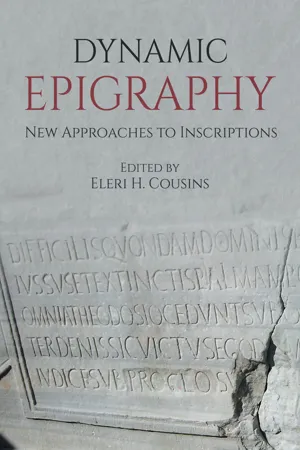
This volume, with origins in a panel at the 2018 Celtic Conference in Classics, presents creative new approaches to epigraphic material, in an attempt to 'shake up' how we deal with inscriptions. Broad themes include the embodied experience of epigraphy, the unique capacities of epigraphic language as a genre, the visuality of inscriptions and the interplay of inscriptions with literary texts. Although each chapter focuses on specific objects and epigraphic landscapes, ranging from Republican Rome to early modern Scotland, the emphasis here is on using these case studies not as an end in themselves, but as a means of exploring broader methodological and theoretical issues to do with how we use inscriptions as evidence, both for the Greco-Roman world and for other time periods. Drawing on conversations from fields such as archaeology and anthropology, philology, art history, linguistics and history, contributors also seek to push the boundaries of epigraphy as a discipline and to demonstrate the analytical fruits of interdisciplinary approaches to inscribed material. Methodologies such as phenomenology, translingualism, intertextuality and critical fabulation are deployed to offer new perspectives on the social functions of inscriptions as texts and objects and to open up new horizons for the use of inscriptions as evidence for past societies.
Information
Subtopic
European Medieval HistoryIndex
Social SciencesTable of contents
- Contents
- List of figures
- List of abbreviations
- Editor’s acknowledgements
- Chapter 1 Introduction: thoughts on the nature of inscriptions
- Chapter 2 Towards a theoretical model of the epigraphic landscape
- Chapter 3 Materializing epigraphy: archaeological and sociolinguistic approaches to Roman inscribed spindle whorls
- Chapter 4 Written to be (un)read, written to be seen: beyond Latin codes in Latin epigraphy
- Chapter 5 Epigraphic strategies of communication: the visual accusative of Roman Republican dedications of spoils
- Chapter 6 Inscribing the artistic space: blurred boundaries on Romano-British tombstones
- Chapter 7 When poetry comes to its senses:* inscribed Roman verse and the human sensorium
- Chapter 8 Lassi viatores: poetic consumption between Martial’s Epigrams and the Carmina Latina Epigraphica
- Chapter 9 Epigraphy and critical fabulation: imagining narratives of Greco-Roman sexual slavery
Trusted by 375,005 students
Access to over 1.5 million titles for a fair monthly price.
Study more efficiently using our study tools.
Frequently asked questions
Yes, you can cancel anytime from the Subscription tab in your account settings on the Perlego website. Your subscription will stay active until the end of your current billing period. Learn how to cancel your subscription
No, books cannot be downloaded as external files, such as PDFs, for use outside of Perlego. However, you can download books within the Perlego app for offline reading on mobile or tablet. Learn how to download books offline
Perlego offers two plans: Essential and Complete
- Essential is ideal for learners and professionals who enjoy exploring a wide range of subjects. Access the Essential Library with 800,000+ trusted titles and best-sellers across business, personal growth, and the humanities. Includes unlimited reading time and Standard Read Aloud voice.
- Complete: Perfect for advanced learners and researchers needing full, unrestricted access. Unlock 1.5M+ books across hundreds of subjects, including academic and specialized titles. The Complete Plan also includes advanced features like Premium Read Aloud and Research Assistant.
We are an online textbook subscription service, where you can get access to an entire online library for less than the price of a single book per month. With over 1.5 million books across 990+ topics, we’ve got you covered! Learn about our mission
Look out for the read-aloud symbol on your next book to see if you can listen to it. The read-aloud tool reads text aloud for you, highlighting the text as it is being read. You can pause it, speed it up and slow it down. Learn more about Read Aloud
Yes! You can use the Perlego app on both iOS and Android devices to read anytime, anywhere — even offline. Perfect for commutes or when you’re on the go.
Please note we cannot support devices running on iOS 13 and Android 7 or earlier. Learn more about using the app
Please note we cannot support devices running on iOS 13 and Android 7 or earlier. Learn more about using the app
Yes, you can access Dynamic Epigraphy by Eleri H. Cousins in PDF and/or ePUB format, as well as other popular books in Social Sciences & European Medieval History. We have over 1.5 million books available in our catalogue for you to explore.