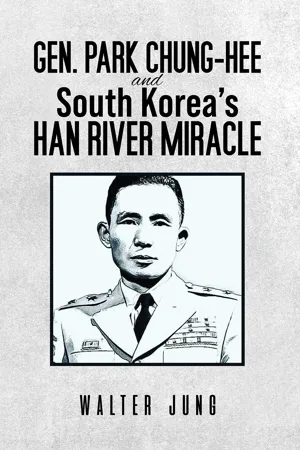
Gen. Park Chung-Hee was born to a poor family in rural Korea when Japan ruled the nation as a colony. After teaching at a rural elementary school for three years, he studied at three different military academies to become an army officer in the liberated Korea. Although he encountered a career-threatening crisis right before the outbreak of the Korean War, he returned to the service and served many key staff positions during the war and important command positions after the war with devoted professionalism. When the nation drifted rudderless in the 1960s, he led the military revolution as the last resort. Hence forth he headed the government that was steadfastly focused on rebuilding the nation. His administration laid the extensive, future-oriented foundation for the nation's industrial development and advanced defense capability. Gen. Park lived his life aligned with, to the letter, his personal motto: 'My Whole Life to Fatherland.'
- 294 pages
- English
- ePUB (mobile friendly)
- Available on iOS & Android
eBook - ePub
Gen. Park Chung-Hee and South Korea's Han River Miracle
About this book
Information
Table of contents
- Title Page
- About the Author
- Dedication
- Copyright Information ©
- Acknowledgment
- Introduction
- Chapter One The D-Day Eve
- Chapter Two A Country Teacher Becomes an Officer
- Chapter Three The Korean War
- Chapter Four From Coup Leader to National Leader
- Chapter Five Chief Executive General
- Chapter Six President Park’s Early Trials
- Chapter Seven Responses to Kim Ilsung’s Provocations
- Chapter Eight War on National Economic Development
- Chapter Nine Laying Down National Foundation
- Chapter Ten Revolutionary Statesman
- Chapter Eleven The End Gen. Park Did Not Deserve
- Epilogue
- Selected Bibliography
Trusted by 375,005 students
Access to over 1.5 million titles for a fair monthly price.
Study more efficiently using our study tools.
Frequently asked questions
Yes, you can cancel anytime from the Subscription tab in your account settings on the Perlego website. Your subscription will stay active until the end of your current billing period. Learn how to cancel your subscription
No, books cannot be downloaded as external files, such as PDFs, for use outside of Perlego. However, you can download books within the Perlego app for offline reading on mobile or tablet. Learn how to download books offline
We are an online textbook subscription service, where you can get access to an entire online library for less than the price of a single book per month. With over 1.5 million books across 990+ topics, we’ve got you covered! Learn about our mission
Look out for the read-aloud symbol on your next book to see if you can listen to it. The read-aloud tool reads text aloud for you, highlighting the text as it is being read. You can pause it, speed it up and slow it down. Learn more about Read Aloud
Yes! You can use the Perlego app on both iOS and Android devices to read anytime, anywhere — even offline. Perfect for commutes or when you’re on the go.
Please note we cannot support devices running on iOS 13 and Android 7 or earlier. Learn more about using the app
Please note we cannot support devices running on iOS 13 and Android 7 or earlier. Learn more about using the app
Yes, you can access Gen. Park Chung-Hee and South Korea's Han River Miracle by Walter Jung in PDF and/or ePUB format, as well as other popular books in History & Military Biographies. We have over 1.5 million books available in our catalogue for you to explore.