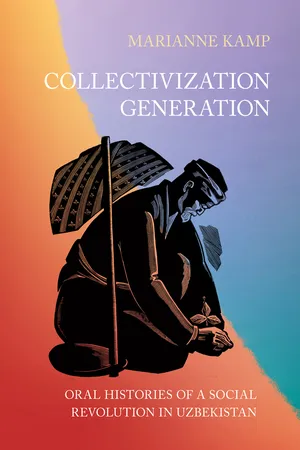
Winner of the Central Eurasian Studies Society Book Award
Collectivization Generation is a history of agricultural collectivization in Soviet Uzbekistan, but it is not focused on Party decisions. Instead, Marianne Kamp offers a history of everyday life that relies on oral history accounts from those she calls the collectivization generation. Born between the early 1900s and the early 1920s, the collectivization generation were rural youth who participated in the transformation of agricultural life in the early 1930s as teens or young adults. A top-down restructuring ruptured their predictable life trajectories and created new categories for understanding self and society. For many, the newly formed kolkhozes became their economic, social, and political milieu throughout their working years, shaping their identities and their material lives. In Collectivization Generation, we meet Uzbeks who were driven from their homes by bandits, whose fathers disappeared in the Stalinist gulag, who suffered starvation and orphanhood. We also meet Uzbeks who told of embracing the project of collectivization, of feeling rewarded with dignity, recognition, pay, association with national triumphs, and with the progress represented by a tractor.