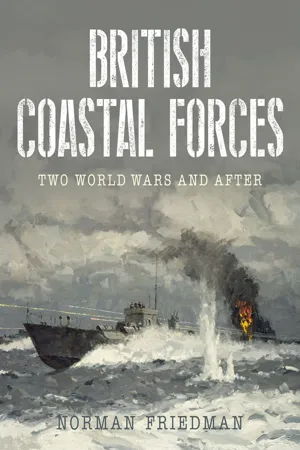
The Royal Navy invented the fast motor torpedo boat during the First World War, and used it and other small coastal craft to great effect during the Second. This book tells the dramatic story of British coastal forces, both offensive and defensive, in both World Wars and beyond. In the Second World War, British coastal forces fought a desperate battle to control the narrow seas, particularly the Channel and the North Sea, and took the war to the coasts of German-occupied Europe, fighting where larger warships could not be risked. They also made a significant contribution to victory in the Mediterranean, but it was primarily warfare in home waters that shaped wartime British Coastal Forces and left lessons for postwar development. In this book, Norman Friedman uniquely connects the technical story of the coastal craft and their weapons and other innovations with the way they fought. In both world wars much of the technology was at the edge of what was feasible at the time. Boats incorporated considerable British innovation and also benefited from important US contributions, particularly in supplying high-powered engines during World War II. In contrast with larger warships, British coastal forces craft were essentially shaped by a few builders, and their part in the story is given full credit. They also built a large number of broadly similar craft for air-sea rescue, and for completeness these are described in an appendix. This fascinating, dramatic story is also relevant to modern naval thinkers concerned with gaining or denying access to hostile shores. The technology has changed but the underlying realities have not. This book includes an extensive account of how coastal forces supported the biggest European example of seizing a defended shore, the Normandy invasion. That was by far the largest single British coastal forces operation, demanding a wide range of innovations to make it possible. Like other books in this series, this one is based very heavily on contemporary official material, much of which has not been used previously – like the extensive reports of US naval observers, who were allowed wide access to the Royal Navy as early as 1940. Combined with published memoirs, these sources offer a much more complete picture than has previously appeared of how Coastal Forces fought and of the way in which various pressures, both operational and industrial, shaped them.
- 400 pages
- English
- ePUB (mobile friendly)
- Available on iOS & Android
eBook - ePub
About this book
Information
Subtopic
20th Century HistoryIndex
HistoryTable of contents
- Cover
- Title
- Copyright
- Contents
- Abbreviations
- Acknowledgements
- 1. Fast Attack Craft and The Royal Navy
- 2. Builders
- 3. Fast Craft
- 4. The First World War
- 5. Post-War Slump
- 6. Fast Craft Revived
- 7. The Special Attack Boat
- 8. ASW And Mine Countermeasures
- 9. Wartime MTBS
- 10. Motor Gun Boats and The E-Boat Crisis
- 11. Special MTBS
- 12. Motor Launches
- 13. Coastal Forces at Normandy
- 14. Coastal Forces Post-War
- Appendix: Air-Sea Rescue Boats
- Notes
- Bibliography
- Coastal Forces Craft Data List
- List of Coastal Forces Craft
Trusted by 375,005 students
Access to over 1.5 million titles for a fair monthly price.
Study more efficiently using our study tools.
Frequently asked questions
Yes, you can cancel anytime from the Subscription tab in your account settings on the Perlego website. Your subscription will stay active until the end of your current billing period. Learn how to cancel your subscription
No, books cannot be downloaded as external files, such as PDFs, for use outside of Perlego. However, you can download books within the Perlego app for offline reading on mobile or tablet. Learn how to download books offline
Perlego offers two plans: Essential and Complete
- Essential is ideal for learners and professionals who enjoy exploring a wide range of subjects. Access the Essential Library with 800,000+ trusted titles and best-sellers across business, personal growth, and the humanities. Includes unlimited reading time and Standard Read Aloud voice.
- Complete: Perfect for advanced learners and researchers needing full, unrestricted access. Unlock 1.5M+ books across hundreds of subjects, including academic and specialized titles. The Complete Plan also includes advanced features like Premium Read Aloud and Research Assistant.
We are an online textbook subscription service, where you can get access to an entire online library for less than the price of a single book per month. With over 1.5 million books across 990+ topics, we’ve got you covered! Learn about our mission
Look out for the read-aloud symbol on your next book to see if you can listen to it. The read-aloud tool reads text aloud for you, highlighting the text as it is being read. You can pause it, speed it up and slow it down. Learn more about Read Aloud
Yes! You can use the Perlego app on both iOS and Android devices to read anytime, anywhere — even offline. Perfect for commutes or when you’re on the go.
Please note we cannot support devices running on iOS 13 and Android 7 or earlier. Learn more about using the app
Please note we cannot support devices running on iOS 13 and Android 7 or earlier. Learn more about using the app
Yes, you can access British Coastal Forces by Norman Friedman in PDF and/or ePUB format, as well as other popular books in History & 20th Century History. We have over 1.5 million books available in our catalogue for you to explore.