Who were the Simonians? Beginning in the mid-second century CE, heresiologists depicted them as licentious followers of the first "gnostic," a supposedly Samarian self-deifier called Simon, who was thought to practice "magic" and became known as the father of all heresies.
Litwa examines the Simonians in their own literature and in the literature used to refute and describe them. He begins with Simonian primary sources, namely The Declaration of Great Power (embedded in the anonymous Refutation of All Heresies) and The Concept of Our Great Power (Nag Hammadi codex VI,4). Litwa argues that both are early second-century products of Simonian authors writing in Alexandria or Egypt. Litwa then moves on to examine the heresiological sources related to the Simonians (Justin, the book of Acts, Irenaeus, the author of the Refutation of All Heresies, Pseudo-Tertullian, Epiphanius, and Filaster). He shows how closely connected Justin's report is to the portrait of Simon in Acts, and offers an extensive exegesis and analysis of Simonian theology and practice based on the reports of Irenaeus and the Refutator. Finally, Litwa examines Simonianism in novelistic sources, namely the Acts of Peter and the Pseudo-Clementines. By the time these sources were written, Simon had become the father of all heresies. Accordingly, virtually any heresy could be attributed to Simon. As a result-despite their alluring portraits of Simon-these sources are mostly unusable for the historical study of the Simonian Christian movement. Litwa concludes with a historical profile of the Simonian movement in the second and third centuries.
The book features appendices which contain Litwa's own translations of primary Simonian texts.
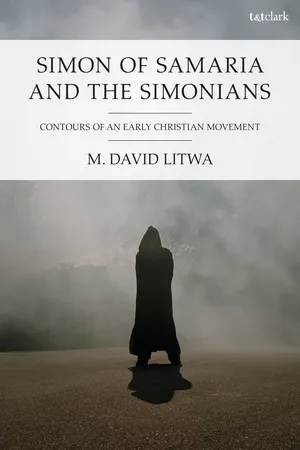
eBook - ePub
Simon of Samaria and the Simonians
Contours of an Early Christian Movement
- 212 pages
- English
- ePUB (mobile friendly)
- Available on iOS & Android
eBook - ePub
About this book
Information
Table of contents
- Cover
- Half Title
- Title Page
- Dedication
- Contents
- List of Figures
- Acknowledgments
- Note on Translations
- List of Abbreviations
- Introduction
- 1 The Great Declaration
- 2 The Concept of Our Great Power
- 3 The Acts of the Apostles
- Interlude: Simon as Cipher
- 4 Justin Martyr
- 5 Irenaeus
- 6 Tertullian
- 7 The Refutator
- 8 Origen of Alexandria
- 9 Eusebius of Caesarea
- 10 Epiphanius, Pseudo-Tertullian, and Filaster
- 11 The Acts of Peter
- 12 The Pseudo-Clementine Homilies
- Conclusion
- Appendix 1: Reconstruction of The Great Declaration
- Appendix 2: Translation of The Concept of Our Great Power
- Bibliography
- Index
- Copyright Page
Trusted by 375,005 students
Access to over 1.5 million titles for a fair monthly price.
Study more efficiently using our study tools.
Frequently asked questions
Yes, you can cancel anytime from the Subscription tab in your account settings on the Perlego website. Your subscription will stay active until the end of your current billing period. Learn how to cancel your subscription
No, books cannot be downloaded as external files, such as PDFs, for use outside of Perlego. However, you can download books within the Perlego app for offline reading on mobile or tablet. Learn how to download books offline
Perlego offers two plans: Essential and Complete
- Essential is ideal for learners and professionals who enjoy exploring a wide range of subjects. Access the Essential Library with 800,000+ trusted titles and best-sellers across business, personal growth, and the humanities. Includes unlimited reading time and Standard Read Aloud voice.
- Complete: Perfect for advanced learners and researchers needing full, unrestricted access. Unlock 1.5M+ books across hundreds of subjects, including academic and specialized titles. The Complete Plan also includes advanced features like Premium Read Aloud and Research Assistant.
We are an online textbook subscription service, where you can get access to an entire online library for less than the price of a single book per month. With over 1.5 million books across 990+ topics, we’ve got you covered! Learn about our mission
Look out for the read-aloud symbol on your next book to see if you can listen to it. The read-aloud tool reads text aloud for you, highlighting the text as it is being read. You can pause it, speed it up and slow it down. Learn more about Read Aloud
Yes! You can use the Perlego app on both iOS and Android devices to read anytime, anywhere — even offline. Perfect for commutes or when you’re on the go.
Please note we cannot support devices running on iOS 13 and Android 7 or earlier. Learn more about using the app
Please note we cannot support devices running on iOS 13 and Android 7 or earlier. Learn more about using the app
Yes, you can access Simon of Samaria and the Simonians by M. David Litwa in PDF and/or ePUB format, as well as other popular books in Theology & Religion & Biblical Studies. We have over 1.5 million books available in our catalogue for you to explore.