This book explores the evolution of Spanish feminism in the context of European feminisms and institutions from the 1960s to recent times.
Beginning with Sección Femenina, the official Francoist women's organization, Feminism, National Identity and European Integration in Modern Spain traces the interplay between Spanish women's policy and international policymaking. In some cases, as with the Sección Femenina-championed Law of Political Rights (Ley de Derechos) in 1961, Spanish women's policy at least appeared more progressive than what Western democracies offered – notable at a time when Spain was considered backward. After Franco's death in 1975, Spain's democratic transition seemingly consolidated forward-thinking women's policy with a Constitution that guaranteed equality of the sexes in 1978, and with the creation of a national bureau charged with crafting women's policy, the Instituto de la Mujer (Women's Institute), in 1983.
Yet feminists found themselves marginalized in Spanish political decision-making, as Kathryn L. Mahaney argues so successfully in this study. Mahaney reveals that women ultimately influenced domestic policy not by acting within national networks but by leveraging European connections, particularly after Spain joined the European Economic Community (EEC) in 1986. The book shows that Spanish feminists worked through the EEC to gain international approval of policies that had met domestic opposition, and did so by representing them as necessary litmus tests of nations' democratic integrity. Their proposals were shaped by the specific context of Spanish feminism, but also by Spanish debates about what rights democracies should grant women and what equality in a post-fascist nation should encompass. This ground-breaking study explains that, in turn, these processes shaped both Spain's and the European Union's much-prized self-identities as democratic communities.
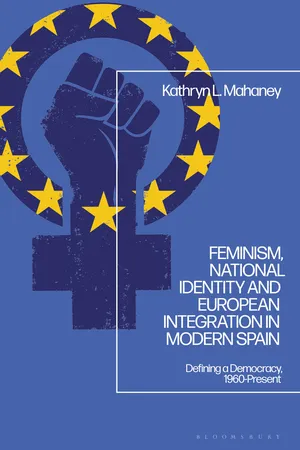
eBook - ePub
Feminism, National Identity and European Integration in Modern Spain
Defining a Democracy, 1960-Present
- 210 pages
- English
- ePUB (mobile friendly)
- Available on iOS & Android
eBook - ePub
Feminism, National Identity and European Integration in Modern Spain
Defining a Democracy, 1960-Present
About this book
Information
Table of contents
- Cover
- Halftitle Page
- Dedication Page
- Title Page
- Contents
- Acknowledgments
- Introduction
- 1 Female Sentinels of Occident: The Sección Femenina, Women’s Rights, and Francoist Spain’s Search for International Acceptance in Postwar Western Europe
- 2 “What We Want is For Each Woman to Be Her Own Protagonist”: Re-examining the Feminist “Triumphs” of Transition-Era Spain
- 3 Transnationalizing the Transition and Beyond: How Domestic Feminist Conflict and Global Feminist Networks Affected Late Twentieth-Century Spanish Politics
- 4 Violent Inequalities: Debates on Intimate Partner Violence, Gender Equality, and the Ongoing Struggle to Define Post-Francoist Democratic Spain
- 5 Conclusions: “La Lucha Continúa,” the Struggle Continues
- Notes
- Bibliography
- Index
- Imprint
Trusted by 375,005 students
Access to over 1.5 million titles for a fair monthly price.
Study more efficiently using our study tools.
Frequently asked questions
Yes, you can cancel anytime from the Subscription tab in your account settings on the Perlego website. Your subscription will stay active until the end of your current billing period. Learn how to cancel your subscription
No, books cannot be downloaded as external files, such as PDFs, for use outside of Perlego. However, you can download books within the Perlego app for offline reading on mobile or tablet. Learn how to download books offline
Perlego offers two plans: Essential and Complete
- Essential is ideal for learners and professionals who enjoy exploring a wide range of subjects. Access the Essential Library with 800,000+ trusted titles and best-sellers across business, personal growth, and the humanities. Includes unlimited reading time and Standard Read Aloud voice.
- Complete: Perfect for advanced learners and researchers needing full, unrestricted access. Unlock 1.5M+ books across hundreds of subjects, including academic and specialized titles. The Complete Plan also includes advanced features like Premium Read Aloud and Research Assistant.
We are an online textbook subscription service, where you can get access to an entire online library for less than the price of a single book per month. With over 1.5 million books across 990+ topics, we’ve got you covered! Learn about our mission
Look out for the read-aloud symbol on your next book to see if you can listen to it. The read-aloud tool reads text aloud for you, highlighting the text as it is being read. You can pause it, speed it up and slow it down. Learn more about Read Aloud
Yes! You can use the Perlego app on both iOS and Android devices to read anytime, anywhere — even offline. Perfect for commutes or when you’re on the go.
Please note we cannot support devices running on iOS 13 and Android 7 or earlier. Learn more about using the app
Please note we cannot support devices running on iOS 13 and Android 7 or earlier. Learn more about using the app
Yes, you can access Feminism, National Identity and European Integration in Modern Spain by Kathryn L. Mahaney in PDF and/or ePUB format, as well as other popular books in History & 20th Century History. We have over 1.5 million books available in our catalogue for you to explore.