Combining perspectives from both continental and analytic philosophy, this timely volume explores how imagination today both shapes and is shaped by technology, art and ethics.
Imagination is one of the most significant and broadly examined concepts in contemporary philosophy and is frequently understood as a basic human faculty that enables complex activities. This book shows, however, that imagination is more than a mere enabler. Whilst imagination shapes our experiences, it is at the same time shaped by our environments. Some of the most creative manifestations of imagination are the result of its two-way interaction with art or technology, or both. In short, imagination co-shapes us.
Beyond the traditional perspectives of Kant and Heidegger, The Philosophy of Imagination: Technology, Art and Ethics examines our dynamic relationship with imagination, from contemporary technological advancements such as AI that transform the whole ecosystem to imagination in the context of videogames and literary fiction. Analysing societal imagination, it addresses the relationship between the racial imaginary and white ignorance, as well as the effects that societal mechanisms such as lockdowns can have on our imagination.
Taking its cue from the here and now, this volume brings together leading international scholars to investigate how the concept of co-shaping allows us to see imagination and its crucial role in society in new and productive ways.
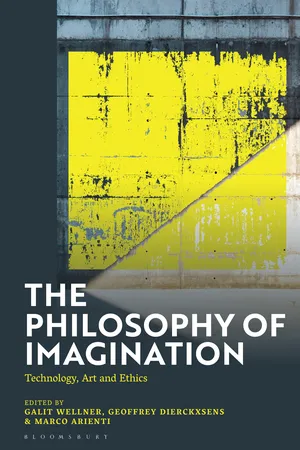
eBook - ePub
The Philosophy of Imagination
Technology, Art and Ethics
- 246 pages
- English
- ePUB (mobile friendly)
- Available on iOS & Android
eBook - ePub
The Philosophy of Imagination
Technology, Art and Ethics
About this book
Information
Table of contents
- Cover
- Half-Title
- Series Page
- Title Page
- Contents
- Editors’ Introduction
- Part I Imagination and Technology
- 1 Technologically Related Imagination: Postphenomenology and the Art of Dibutades
- 2 Can Algorithms Imagine?
- 3 Emaginary; or Why the Essence of (Digital) Technology Is by No Means Entirely Technological
- 4 Techno-Activism
- Part II Imagination and Ethics
- 5 White Ignorance and the Racial Imaginary
- 6 Moving in a World You Cannot See: From Imaginative Perception to Creative Moral Imagination
- 7 Narrative and Imagination in Times of Global Pandemics
- Part III Imagination and Art
- 8 Poetic Imagination and Technology: A Dialectical Assessment
- 9 Am I in Wonderland as Alice Is? The First-Person Perspective in Imaginative Art and Game Experiences
- 10 Representation, Expression, Exemplification: Paul Ricoeur, Nelson Goodman, and the Role of Imagination in the Metaphorical Process
- 11 Imagination and Images between Phenomenology and Analytic Philosophy
- Part IV Imagination, the Human, and the Contemporary World
- 12 Why Imagination Needs Socratic Ignorance
- 13 Ryle and Sartre against Hume’s Theory of the Imagination
- 14 Enactive Imagination: Its Roots and Contemporary Horizons
- 15 Phantasy and Technologically Embedded Imagination: A Phenomenological and Postphenomenological Analysis
- Notes
- List of Contributors
- Index
- Copyright Page
Trusted by 375,005 students
Access to over 1.5 million titles for a fair monthly price.
Study more efficiently using our study tools.
Frequently asked questions
Yes, you can cancel anytime from the Subscription tab in your account settings on the Perlego website. Your subscription will stay active until the end of your current billing period. Learn how to cancel your subscription
No, books cannot be downloaded as external files, such as PDFs, for use outside of Perlego. However, you can download books within the Perlego app for offline reading on mobile or tablet. Learn how to download books offline
Perlego offers two plans: Essential and Complete
- Essential is ideal for learners and professionals who enjoy exploring a wide range of subjects. Access the Essential Library with 800,000+ trusted titles and best-sellers across business, personal growth, and the humanities. Includes unlimited reading time and Standard Read Aloud voice.
- Complete: Perfect for advanced learners and researchers needing full, unrestricted access. Unlock 1.5M+ books across hundreds of subjects, including academic and specialized titles. The Complete Plan also includes advanced features like Premium Read Aloud and Research Assistant.
We are an online textbook subscription service, where you can get access to an entire online library for less than the price of a single book per month. With over 1.5 million books across 990+ topics, we’ve got you covered! Learn about our mission
Look out for the read-aloud symbol on your next book to see if you can listen to it. The read-aloud tool reads text aloud for you, highlighting the text as it is being read. You can pause it, speed it up and slow it down. Learn more about Read Aloud
Yes! You can use the Perlego app on both iOS and Android devices to read anytime, anywhere — even offline. Perfect for commutes or when you’re on the go.
Please note we cannot support devices running on iOS 13 and Android 7 or earlier. Learn more about using the app
Please note we cannot support devices running on iOS 13 and Android 7 or earlier. Learn more about using the app
Yes, you can access The Philosophy of Imagination by Galit Wellner, Geoffrey Dierckxsens, Marco Arienti, Galit Wellner,Geoffrey Dierckxsens,Marco Arienti in PDF and/or ePUB format, as well as other popular books in Philosophy & Aesthetics in Philosophy. We have over 1.5 million books available in our catalogue for you to explore.