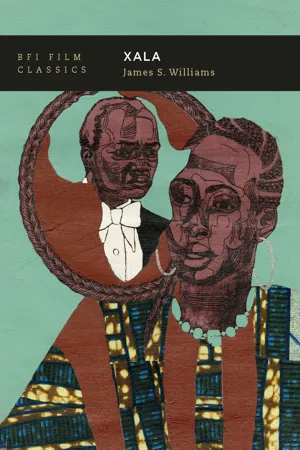
Xala (1974) by the pioneering Senegalese director Ousmane Sembene, was acclaimed on its release for its scorching critique of postcolonial African society, and it cemented Sembene's status as a wholly new kind of politically engaged, pan-African, auteur film-maker. Centring on the story of businessman El Hadji and the impotence that afflicts him on his marriage to a young third wife, Xala vividly captures the cultural and political upheaval of 1970s Senegal, while suggesting the radical potential of dissent, solidarity and collective action, embodied by El Hadji's student daughter Rama and the group of urban 'undesirables' who act as a kind of raw chorus to the affairs of the neocolonial elite.
James S. Williams's lucid study traces Xala's difficult production history and analyses its daring combination of political and domestic drama, oral narrative, social realism, symbolism, satire, documentary, mysticism and Marxist analysis. Yet from its dazzling extended opening sequence of revolution as performance to its suspended climax of redemption through ritualised spitting, Xala presents a series of conceptual and formal challenges that resist a simple reading of the film as allegory.
Highlighting often overlooked elements of Sembene's intricate, experimental film-making, including provocative shifts in mood and poetic, even subversively erotic, moments, Williams reveals Xala as a visionary work of both African cinema and Third Cinema that extended the parameters of postcolonial film practice and still resounds today with its searing inventive power.
eBook - ePub
Xala
About this book
Information
Table of contents
- Cover
- BFI Film Classics
- Title Page
- Contents
- Acknowledgments
- 1 Dakar, 1974: The Politics of Setting and Film Production
- 2 Africanity ≠ Africa: For an African Third Cinema
- 3 Defetishising the Fetish
- 4 The Fading Father, or The Future is Feminist
- 5 Resisting the Narrative Curse: Countermoves and Counter-Spaces
- 6 From Evian to Sputum: Abjection as Redemption
- Epilogue: The Legacy of Xala
- Notes
- Credits
- eCopyright
Trusted by 375,005 students
Access to over 1.5 million titles for a fair monthly price.
Study more efficiently using our study tools.
Frequently asked questions
Yes, you can cancel anytime from the Subscription tab in your account settings on the Perlego website. Your subscription will stay active until the end of your current billing period. Learn how to cancel your subscription
No, books cannot be downloaded as external files, such as PDFs, for use outside of Perlego. However, you can download books within the Perlego app for offline reading on mobile or tablet. Learn how to download books offline
Perlego offers two plans: Essential and Complete
- Essential is ideal for learners and professionals who enjoy exploring a wide range of subjects. Access the Essential Library with 800,000+ trusted titles and best-sellers across business, personal growth, and the humanities. Includes unlimited reading time and Standard Read Aloud voice.
- Complete: Perfect for advanced learners and researchers needing full, unrestricted access. Unlock 1.5M+ books across hundreds of subjects, including academic and specialized titles. The Complete Plan also includes advanced features like Premium Read Aloud and Research Assistant.
We are an online textbook subscription service, where you can get access to an entire online library for less than the price of a single book per month. With over 1.5 million books across 990+ topics, we’ve got you covered! Learn about our mission
Look out for the read-aloud symbol on your next book to see if you can listen to it. The read-aloud tool reads text aloud for you, highlighting the text as it is being read. You can pause it, speed it up and slow it down. Learn more about Read Aloud
Yes! You can use the Perlego app on both iOS and Android devices to read anytime, anywhere — even offline. Perfect for commutes or when you’re on the go.
Please note we cannot support devices running on iOS 13 and Android 7 or earlier. Learn more about using the app
Please note we cannot support devices running on iOS 13 and Android 7 or earlier. Learn more about using the app
Yes, you can access Xala by James S. Williams in PDF and/or ePUB format, as well as other popular books in Media & Performing Arts & Film & Video. We have over 1.5 million books available in our catalogue for you to explore.