Luchino Visconti's The Leopard (Il Gattopardo, 1963) tells the story of an aristocratic Sicilian family adjusting to the realities of political and commercial modernity after the unification Italy during the Risorgimento.
The film, starring Claudia Cardinale, Burt Lancaster and Alain Delon, met with success upon its initial release, winning the Palme d'Or at Cannes and having a successful theatrical run in Europe. Despite this, however, it did not do well with English-speaking audiences, and eventually even fell out of favour with Italian audiences, who took issue with the way Risorgimento history was represented.
David Weir's study of the film seeks to understand the film's paradoxical place in Italian film history. He argues that Visconti's use of artifice, narrative and history, all aspects that came to be criticised, were in fact, essential to his cinematic art, and can all be understood as strengths of the film. Providing a scene-by-scene analysis of the film, as well as illuminating its relationship to the Lampedusa novel from which it was adapted, Weir suggests that Visconti's film goes beyond mere adaptation, using the form of the novel for cinematic purposes and making The Leopard a cinematic novel in its own right.
He goes on to situate the film within Visconti's career, questioning whether the uneven reception of the film reflects the paradox of Visconti's social status as a Marxist aristocrat and his position as an auteur director whose films borrowed heavily from the decadent tradition, while at the same time professing allegiance to the Italian Communist Party.
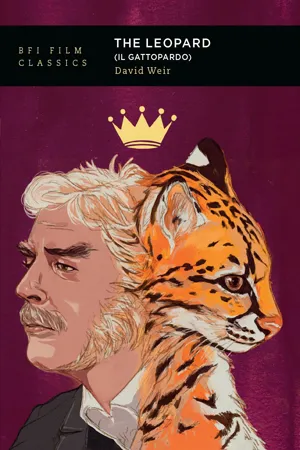
- 120 pages
- English
- ePUB (mobile friendly)
- Available on iOS & Android
eBook - ePub
The Leopard (Il Gattopardo)
About this book
Information
Table of contents
- Cover
- BFI Film Classics
- Title Page
- Contents
- Acknowledgments
- 1 The Source
- 2 The Director
- 3 The Production
- 4 The Film
- 5 The Reception
- Notes
- Credits
- eCopyright
Trusted by 375,005 students
Access to over 1.5 million titles for a fair monthly price.
Study more efficiently using our study tools.
Frequently asked questions
Yes, you can cancel anytime from the Subscription tab in your account settings on the Perlego website. Your subscription will stay active until the end of your current billing period. Learn how to cancel your subscription
No, books cannot be downloaded as external files, such as PDFs, for use outside of Perlego. However, you can download books within the Perlego app for offline reading on mobile or tablet. Learn how to download books offline
Perlego offers two plans: Essential and Complete
- Essential is ideal for learners and professionals who enjoy exploring a wide range of subjects. Access the Essential Library with 800,000+ trusted titles and best-sellers across business, personal growth, and the humanities. Includes unlimited reading time and Standard Read Aloud voice.
- Complete: Perfect for advanced learners and researchers needing full, unrestricted access. Unlock 1.5M+ books across hundreds of subjects, including academic and specialized titles. The Complete Plan also includes advanced features like Premium Read Aloud and Research Assistant.
We are an online textbook subscription service, where you can get access to an entire online library for less than the price of a single book per month. With over 1.5 million books across 990+ topics, we’ve got you covered! Learn about our mission
Look out for the read-aloud symbol on your next book to see if you can listen to it. The read-aloud tool reads text aloud for you, highlighting the text as it is being read. You can pause it, speed it up and slow it down. Learn more about Read Aloud
Yes! You can use the Perlego app on both iOS and Android devices to read anytime, anywhere — even offline. Perfect for commutes or when you’re on the go.
Please note we cannot support devices running on iOS 13 and Android 7 or earlier. Learn more about using the app
Please note we cannot support devices running on iOS 13 and Android 7 or earlier. Learn more about using the app
Yes, you can access The Leopard (Il Gattopardo) by David Weir in PDF and/or ePUB format, as well as other popular books in Media & Performing Arts & Film & Video. We have over 1.5 million books available in our catalogue for you to explore.