'We live,' according to Adam Kotsko, 'in an awkward age.' While this condition may present some challenges, it may also help us to be more attuned to awkwardness in other ages. This book pairs medieval texts with twenty-first century films or television programmes to explore what the resonance between them can tell us about living together in an awkward age.
In this nuanced and engaging study, David Watt focuses especially, but not exclusively, on the 15th century, which seems to intervene awkwardly in the literary trajectory between Chaucer and the Renaissance. This book's hypothesis is that the social discomfort depicted and engendered by writers as diverse as Thomas Hoccleve, Margery Kempe, and Sir Thomas Malory is a feature rather than a flaw. Laughter and Awkwardness in Late Medieval England explains that these authors have a great deal in common with other fifteenth-century authors, who generated embodied experiences of social discomfort in a range of genres by adopting and adapting literary techniques used by their predecessors and successors in slightly different ways. Like the twenty-first century texts with which they are paired, the late-medieval texts that feature in this book use the relationship between laughter and awkwardness to ask what it means to live with each other and how we can learn to live with ourselves.
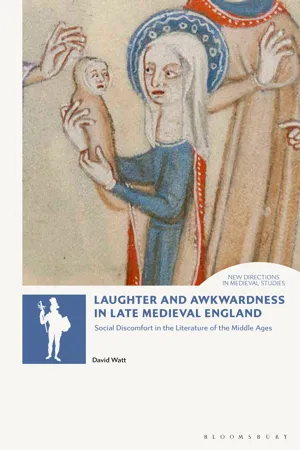
eBook - ePub
Laughter and Awkwardness in Late Medieval England
Social Discomfort in the Literature of the Middle Ages
- 208 pages
- English
- ePUB (mobile friendly)
- Available on iOS & Android
eBook - ePub
Laughter and Awkwardness in Late Medieval England
Social Discomfort in the Literature of the Middle Ages
About this book
Information
Table of contents
- Cover
- Halftitle Page
- Title Page
- Contents
- List of figures
- List of abbreviations
- Note on quotations
- Acknowledgements
- Introduction
- 1 When everything goes pear-shaped: Laughter and awkwardness in Augustine’s Confessions
- 2 Elated or gassy? Between affect and emotion in the Luttrell Psalter
- 3 May this be true? The awkwardness of accepting grace in Pearl
- 4 Creating tension: Laughter and anger in Cleanness
- 5 Virtuous even if it displeases: Patience
- 6 The games people play: Laughter and belonging in Sir Gawain and the Green Knight
- 7 All shall be well: Laughter and belonging in Julian of Norwich’s Revelations of Divine Love
- 8 Too much information? Suggestive diction in ‘I have a Gentil Cock’
- 9 Does this stress make me look fat? Awkward questions in Thomas Hoccleve’s La Male Regle
- 10 You’re so vain, you probably think this Psalm is about you: Saving face in Thomas Hoccleve’s Series
- 11 Great cause to laugh: Conversation and compassion in The Book of Margery Kempe
- 12 Sing with us, with a merry cheer! The awkwardness of going along with it in Mankind
- 13 Ever froward: Standing up for the audience in the Chester Play of Noah’s Flood
- 14 Disappointing expectations: Laughter, awkwardness and the end of Sir Thomas Malory’s Morte Darthur
- Conclusion: An awkward age?
- References
- Index
- Imprint
Trusted by 375,005 students
Access to over 1.5 million titles for a fair monthly price.
Study more efficiently using our study tools.
Frequently asked questions
Yes, you can cancel anytime from the Subscription tab in your account settings on the Perlego website. Your subscription will stay active until the end of your current billing period. Learn how to cancel your subscription
No, books cannot be downloaded as external files, such as PDFs, for use outside of Perlego. However, you can download books within the Perlego app for offline reading on mobile or tablet. Learn how to download books offline
Perlego offers two plans: Essential and Complete
- Essential is ideal for learners and professionals who enjoy exploring a wide range of subjects. Access the Essential Library with 800,000+ trusted titles and best-sellers across business, personal growth, and the humanities. Includes unlimited reading time and Standard Read Aloud voice.
- Complete: Perfect for advanced learners and researchers needing full, unrestricted access. Unlock 1.5M+ books across hundreds of subjects, including academic and specialized titles. The Complete Plan also includes advanced features like Premium Read Aloud and Research Assistant.
We are an online textbook subscription service, where you can get access to an entire online library for less than the price of a single book per month. With over 1.5 million books across 990+ topics, we’ve got you covered! Learn about our mission
Look out for the read-aloud symbol on your next book to see if you can listen to it. The read-aloud tool reads text aloud for you, highlighting the text as it is being read. You can pause it, speed it up and slow it down. Learn more about Read Aloud
Yes! You can use the Perlego app on both iOS and Android devices to read anytime, anywhere — even offline. Perfect for commutes or when you’re on the go.
Please note we cannot support devices running on iOS 13 and Android 7 or earlier. Learn more about using the app
Please note we cannot support devices running on iOS 13 and Android 7 or earlier. Learn more about using the app
Yes, you can access Laughter and Awkwardness in Late Medieval England by David Watt in PDF and/or ePUB format, as well as other popular books in History & British History. We have over 1.5 million books available in our catalogue for you to explore.