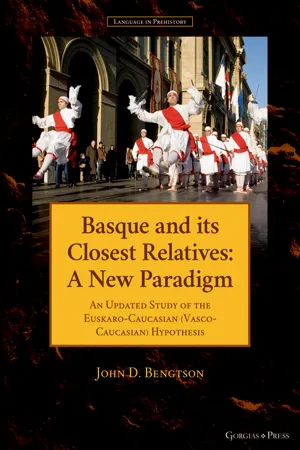
This book is a comprehensive and detailed treatment of the Euskaro-Caucasian hypothesis – the proposal that the Basque language is most closely related to the North Caucasian language family. A more or less similar hypothesis was developed in the twentieth century by prominent scholars, including C.C. Uhlenbeck, Georges Dumézil, and René Lafon. The efforts of these savants, and others, while important, were rather sporadic and consisted of scattered articles, and they never developed a comprehensive phonological and morphological model of Euskaro-Caucasian. Their work on the hypothesis ceased with the death of the last of them, Dumézil, in 1986. On the other hand, thanks to advances in our understanding of Basque phonology and etymology, and in North Caucasian phonology and etymology, and improved linguistic methods, it has become possible to develop a comprehensive Euskaro-Caucasian phonological structure, including regular sound correspondences of vowels and consonants supported by significant numbers of etymologies. These correspondences, in turn, have allowed the author to evaluate objectively the etymological proposals of earlier investigators (which led to the modification or outright rejection of many of them), and have also provided clues to discovering some original etymologies. The nucleus of the Euskaro-Caucasian hypothesis is "old, " beginning in the nineteenth century, but the "new paradigm" alluded to in the provisional title refers to (a) a focus on the North Caucasian language family as the closest surviving relative of Basque (as opposed to the "South Caucasian" = Kartvelian family), (b) a new and comprehensive scheme of comparative phonology, (c) new discoveries in comparative morphology, and (d) several hundred lexical and grammatical etymologies that supersede the more haphazard comparisons offered in earlier works.
- 548 pages
- English
- PDF
- Available on iOS & Android
eBook - PDF
About this book
Information
Table of contents
- Table of Contents
- ACKNOWLEDGMENTS
- Foreword
- INTRODUCTION
- I. Exercise 1: An Experiment in Classification (Taxonomy)
- II. Exercise 2: A Different Approach
- III. Dialects of Basque
- IV. Basque Phonology in Euskaro-Caucasian Perspective
- V. Basque Morphology in Euskaro-Caucasian Perspective
- VI. North Caucasian Phonology in Euskaro-Caucasian Perspective
- VII. Euskaro-Caucasian Comparative Phonology I: Introduction
- VIII. Euskaro-Caucasian Comparative Phonology II: Vowels
- IX. Euskaro-Caucasian Comparative Phonology III: Consonants
- X. Euskaro-Caucasian Comparative Phonology IV: “Irregular” Phonetic Changes: Metathesis, Haplology, Assimilation, Dissimilation, Expressive Forms, Contamination and Blending
- XI. Euskaro-Caucasian Comparative Phonology V: Some Special Etymological Problems
- XII. Euskaro-Caucasian Etymologies: Introduction
- XIII. Euskaro-Caucasian Etymologies A: Anatomical Terms
- XIV. Euskaro-Caucasian: Genetic Linguistics, Archaeology, and Human Genetics
- Abbreviations
- References
- Guide to Phonetic Transcriptions
- Appendix A: Rosters of the most historically stable lexicon
- Appendix B: The Position of Kartvelian
- Appendix C: A Discussion of the Lexicostatistical Study by Tovar, et al. (1961)
- Index I: Basque to English
- Index II: English (semantic)
- About the Author
Trusted by 375,005 students
Access to over 1.5 million titles for a fair monthly price.
Study more efficiently using our study tools.
Frequently asked questions
Yes, you can cancel anytime from the Subscription tab in your account settings on the Perlego website. Your subscription will stay active until the end of your current billing period. Learn how to cancel your subscription
No, books cannot be downloaded as external files, such as PDFs, for use outside of Perlego. However, you can download books within the Perlego app for offline reading on mobile or tablet. Learn how to download books offline
Perlego offers two plans: Essential and Complete
- Essential is ideal for learners and professionals who enjoy exploring a wide range of subjects. Access the Essential Library with 800,000+ trusted titles and best-sellers across business, personal growth, and the humanities. Includes unlimited reading time and Standard Read Aloud voice.
- Complete: Perfect for advanced learners and researchers needing full, unrestricted access. Unlock 1.5M+ books across hundreds of subjects, including academic and specialized titles. The Complete Plan also includes advanced features like Premium Read Aloud and Research Assistant.
We are an online textbook subscription service, where you can get access to an entire online library for less than the price of a single book per month. With over 1.5 million books across 990+ topics, we’ve got you covered! Learn about our mission
Look out for the read-aloud symbol on your next book to see if you can listen to it. The read-aloud tool reads text aloud for you, highlighting the text as it is being read. You can pause it, speed it up and slow it down. Learn more about Read Aloud
Yes! You can use the Perlego app on both iOS and Android devices to read anytime, anywhere — even offline. Perfect for commutes or when you’re on the go.
Please note we cannot support devices running on iOS 13 and Android 7 or earlier. Learn more about using the app
Please note we cannot support devices running on iOS 13 and Android 7 or earlier. Learn more about using the app
Yes, you can access Basque and its Closest Relatives by John Bengtson in PDF and/or ePUB format, as well as other popular books in Languages & Linguistics & Ancient Languages. We have over 1.5 million books available in our catalogue for you to explore.