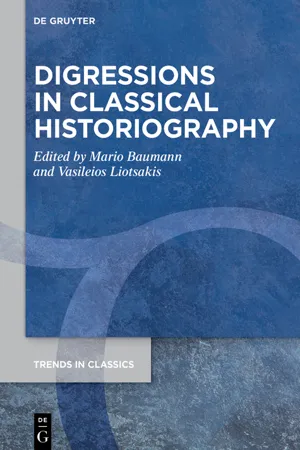
Although digressive discourse constitutes a key feature of Greco-Roman historiography, we possess no collective volume on the matter. The chapters of this book fill this gap by offering an overall view of the use of digressions in Greco-Roman historical prose from its beginning in the 5th century BCE up to the Imperial Era. Ancient historiographers traditionally took as digressions the cases in which they interrupted their focused chronological narration. Such cases include lengthy geographical descriptions, prolepses or analepses, and authorial comments. Ancient historiographers rarely deign to interrupt their narration's main storyline with excursuses which are flagrantly disconnected from it. Instead, they often "coat" their digressions with distinctive patterns of their own thinking, thus rendering them ideological and thematic milestones within an entire work. Furthermore, digressions may constitute pivotal points in the very structure of ancient historical narratives, while ancient historians also use excursuses to establish a dialogue with their readers and to activate them in various ways. All these aspects of digressions in Greco-Roman historiography are studied in detail in the chapters of this volume.
- 364 pages
- English
- ePUB (mobile friendly)
- Available on iOS & Android
eBook - ePub
Digressions in Classical Historiography
About this book
Information
Table of contents
- Title Page
- Copyright
- Contents
- Preface
- Introduction
- Digressive Anecdotes, Narrative Excursus and Historical Thought in Herodotus
- “I Have Written about It and Have Made This Digression from My Account …”: Thucydides’ Digressions and Their Relation to the Main Work
- Emulating Herodotus: Digressions in the First Generation of Alexander Historians
- Polybius’ Histories: No Room for Digressions?
- Why Charondas Taught the Thurians How to Read and Write, or: Digression and Narration in Diodorus’ Bibliotheke
- Going in Circles: Digressive Behavior in Caesar, BC 2.23–44
- Expansion, Heterogeneity and Method in Sallust’s Digressions
- Inglorious History and the Tacitean Digression
- Digressions as Meta-Literary Markers and Narrative Milestones in Arrian’s Anabasis of Alexander
- Digressions and the Fall of the Republic in Cassius Dio
- Digressions in Herodian’s History of the Empire
- Ammianus’ Digressions and their Narrative Impact
- List of Contributors
- Index Locorum
- Index Nominum et Rerum
Trusted by 375,005 students
Access to over 1.5 million titles for a fair monthly price.
Study more efficiently using our study tools.
Frequently asked questions
Yes, you can cancel anytime from the Subscription tab in your account settings on the Perlego website. Your subscription will stay active until the end of your current billing period. Learn how to cancel your subscription
No, books cannot be downloaded as external files, such as PDFs, for use outside of Perlego. However, you can download books within the Perlego app for offline reading on mobile or tablet. Learn how to download books offline
Perlego offers two plans: Essential and Complete
- Essential is ideal for learners and professionals who enjoy exploring a wide range of subjects. Access the Essential Library with 800,000+ trusted titles and best-sellers across business, personal growth, and the humanities. Includes unlimited reading time and Standard Read Aloud voice.
- Complete: Perfect for advanced learners and researchers needing full, unrestricted access. Unlock 1.5M+ books across hundreds of subjects, including academic and specialized titles. The Complete Plan also includes advanced features like Premium Read Aloud and Research Assistant.
We are an online textbook subscription service, where you can get access to an entire online library for less than the price of a single book per month. With over 1.5 million books across 990+ topics, we’ve got you covered! Learn about our mission
Look out for the read-aloud symbol on your next book to see if you can listen to it. The read-aloud tool reads text aloud for you, highlighting the text as it is being read. You can pause it, speed it up and slow it down. Learn more about Read Aloud
Yes! You can use the Perlego app on both iOS and Android devices to read anytime, anywhere — even offline. Perfect for commutes or when you’re on the go.
Please note we cannot support devices running on iOS 13 and Android 7 or earlier. Learn more about using the app
Please note we cannot support devices running on iOS 13 and Android 7 or earlier. Learn more about using the app
Yes, you can access Digressions in Classical Historiography by Mario Baumann,Vasileios Liotsakis in PDF and/or ePUB format, as well as other popular books in History & Ancient & Classical Literary Criticism. We have over 1.5 million books available in our catalogue for you to explore.