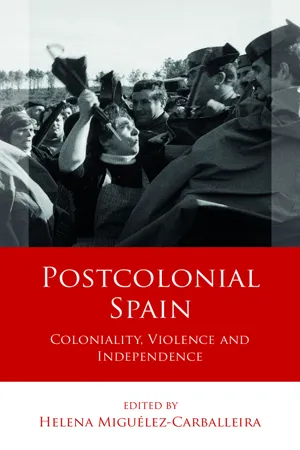
At times explosive, at times restrained, the question of independence has been a fundamental force shaping contemporary Spain. However, the discipline of Spanish (Peninsular) studies has been slow to consider the reality of internal anticolonial and self-determination movements in Spain as part of their purview. To redress this, the present study engages postcolonial theory to shed light on the question of Spain's ongoing internal national conflict, arguing that modern manifestations of such conflict are linked to internal demands for national sovereignty, independence and self-determination forged against the backdrop of Spain's post-imperial crisis after 1898.
The collection ranges across topics such as late nineteenth-century penitentiary discourses, the biopolitics of Francoist agrarian reform, dispossession and mass tourism in Mallorca, the judiciary aftermath of the Catalan referendum on independence of 2017, and post-ETA memory politics. Collectively, they illuminate the conflict zones of contemporary Spanish culture, where questions related to (contested) internal colonialities and independence are enmeshed with the processes of political emancipation and state repression.
- 256 pages
- English
- ePUB (mobile friendly)
- Available on iOS & Android
eBook - ePub
About this book
Information
Table of contents
- Cover
- Title Page
- Copyright Page
- Contents
- Series Editors’ Foreword
- Acknowledgements
- List of Illustrations
- Notes on Contributors
- Introduction The Spanish Postcolonial Continuum: Contested Internal Colonialities in the Long Spanish Twentieth Century
- Chapter 1: Otherness and Corporal Precarity: On the Representation of Torture in Post-Franco Spain
- Chapter 2: The Spanish State of Catalan Exception: Building the Necessity behind Exceptional Rule on Catalan Independence
- Chapter 3: The Persistence of Neocolonial Logic in Fernando León de Aranoa’s Amador
- Chapter 4: Contemporary Majorcan Culture and the Transnational Tourist Gaze: Colonial Dynamics, Cultural Identity and Spatial Dispossession
- Chapter 5: Conflict as a Place of Consensus: The Representation of Political Violence in Harkaitz Cano’s Twist and Ramon Saizarbitoria’s Martutene
- Chapter 6: Pakean Utzi Arte: Art and Resistance in Basque Subaltern Memories
- Chapter 7: Truncated Modernities: Chillida, Tindaya, Fuerteventura
- Chapter 8: The Spanish Rural Subject and the Instituto Nacional de Colonización (1939–71): Coloniality, Biopolitics and Memory
- Chapter 9: Hegemonic Memory Politics and the Basque Nationalist Party: Antifascism and the Question of Violence
- Chapter 10: The Failed Panopticon? Architecture, Social Projects and the Problematic Notion of ‘Model’ in Barcelona’s La Model Prison
- Endnotes
Trusted by 375,005 students
Access to over 1.5 million titles for a fair monthly price.
Study more efficiently using our study tools.
Frequently asked questions
Yes, you can cancel anytime from the Subscription tab in your account settings on the Perlego website. Your subscription will stay active until the end of your current billing period. Learn how to cancel your subscription
No, books cannot be downloaded as external files, such as PDFs, for use outside of Perlego. However, you can download books within the Perlego app for offline reading on mobile or tablet. Learn how to download books offline
We are an online textbook subscription service, where you can get access to an entire online library for less than the price of a single book per month. With over 1.5 million books across 990+ topics, we’ve got you covered! Learn about our mission
Look out for the read-aloud symbol on your next book to see if you can listen to it. The read-aloud tool reads text aloud for you, highlighting the text as it is being read. You can pause it, speed it up and slow it down. Learn more about Read Aloud
Yes! You can use the Perlego app on both iOS and Android devices to read anytime, anywhere — even offline. Perfect for commutes or when you’re on the go.
Please note we cannot support devices running on iOS 13 and Android 7 or earlier. Learn more about using the app
Please note we cannot support devices running on iOS 13 and Android 7 or earlier. Learn more about using the app
Yes, you can access Postcolonial Spain by Helena Miguélez-Carballeira in PDF and/or ePUB format, as well as other popular books in History & 20th Century History. We have over 1.5 million books available in our catalogue for you to explore.