For the first half of the twentieth century, private agreements to impose racial restrictions on who could occupy property decisively shaped the development of American cities and the distribution of people within them. Racial restrictions on the right to buy, sell, or occupy property also effectively truncated the political, social, and economic citizenship of those targeted for exclusion. In Patchwork Apartheid, historian Colin Gordon examines the history of such restrictions and how their consequences reverberate today. Drawing on a unique record of property restrictions excavated from local property records in five Midwestern counties, Gordon documents the prevalence of private property restriction in the era before zoning and building codes were widely employed and before federal redlining sanctioned the segregation of American cities and suburbs. This record of private restriction—documented and mapped to the parcel level in Greater Minneapolis, Greater St. Louis, and two Iowa counties—reveals the racial segregation process both on the ground, in the strategic deployment of restrictions throughout transitional central city neighborhoods and suburbs, and in the broader social and legal construction of racial categories and racial boundaries.
Gordon also explores the role of other policies and practices in sustaining segregation. Enforcement of private racial restrictions was held unconstitutional in 1948, and such agreements were prohibited outright in 1968. But their premises and assumptions, and the segregation they had accomplished, were accommodated by local zoning and federal housing policies. Explicit racial restrictions were replaced by the deceptive business practices of real estate agents and developers, who characterized certain neighborhoods as white and desirable and others as black and undesirable, thereby hiding segregation behind the promotion of sound property investments, safe neighborhoods, and good schools. These practices were in turn replaced by local zoning, which systematically protected white neighborhoods while targeting "blighted" black neighborhoods for commercial and industrial redevelopment, and by a tangle of federal policies that reliably deferred to local and private interests with deep investments in local segregation. Private race restriction was thus a key element in the original segregation of American cities and a source of durable inequalities in housing wealth, housing opportunity, and economic mobility.
Patchwork Apartheid exhaustively documents the history of private restriction in urban settings and demonstrates its crucial role in the ideas and assumptions that have sustained racial segregation in the United States into the twenty-first century.
eBook - ePub
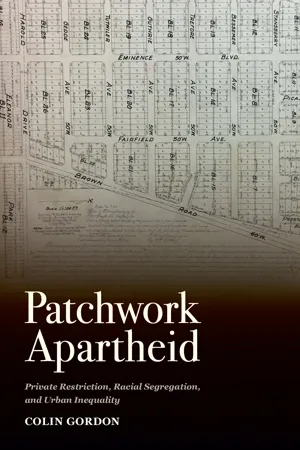
Patchwork Apartheid
Private Restriction, Racial Segregation, and Urban Inequality
- 285 pages
- English
- ePUB (mobile friendly)
- Available on iOS & Android
eBook - ePub
About this book
Information
Table of contents
- Cover Page
- Title Page
- Copyright Page
- Contents
- List of Illustrations
- About the Author
- Acknowledgments
- Chapter 1. Introduction
- Chapter 2. Caucasians Only: Categories, Frames, and Narratives in Private Restriction
- Chapter 3. Dividing the City: Patterns of Private Restriction
- Chapter 4. Patchwork Apartheid: Private Restrictions and Racial Segregation
- Chapter 5. Dress Rehearsal for Shelley: Private Restrictions and the Law
- Chapter 6. Long Shadow: The Durable Inequalities of Private Restriction
- Appendix: Note on Methods
- Notes
- References
- Index
Trusted by 375,005 students
Access to over 1.5 million titles for a fair monthly price.
Study more efficiently using our study tools.
Frequently asked questions
Yes, you can cancel anytime from the Subscription tab in your account settings on the Perlego website. Your subscription will stay active until the end of your current billing period. Learn how to cancel your subscription
No, books cannot be downloaded as external files, such as PDFs, for use outside of Perlego. However, you can download books within the Perlego app for offline reading on mobile or tablet. Learn how to download books offline
Perlego offers two plans: Essential and Complete
- Essential is ideal for learners and professionals who enjoy exploring a wide range of subjects. Access the Essential Library with 800,000+ trusted titles and best-sellers across business, personal growth, and the humanities. Includes unlimited reading time and Standard Read Aloud voice.
- Complete: Perfect for advanced learners and researchers needing full, unrestricted access. Unlock 1.5M+ books across hundreds of subjects, including academic and specialized titles. The Complete Plan also includes advanced features like Premium Read Aloud and Research Assistant.
We are an online textbook subscription service, where you can get access to an entire online library for less than the price of a single book per month. With over 1.5 million books across 990+ topics, we’ve got you covered! Learn about our mission
Look out for the read-aloud symbol on your next book to see if you can listen to it. The read-aloud tool reads text aloud for you, highlighting the text as it is being read. You can pause it, speed it up and slow it down. Learn more about Read Aloud
Yes! You can use the Perlego app on both iOS and Android devices to read anytime, anywhere — even offline. Perfect for commutes or when you’re on the go.
Please note we cannot support devices running on iOS 13 and Android 7 or earlier. Learn more about using the app
Please note we cannot support devices running on iOS 13 and Android 7 or earlier. Learn more about using the app
Yes, you can access Patchwork Apartheid by Colin Gordon in PDF and/or ePUB format, as well as other popular books in History & North American History. We have over 1.5 million books available in our catalogue for you to explore.