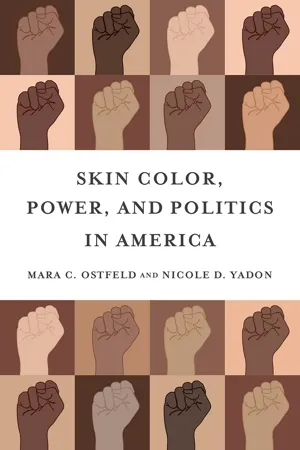
A person's skin color affects their life experiences including income, educational attainment, health outcomes, exposure to discrimination, interactions with the criminal justice system and one's sense of ethnoracial group belonging. But, do these disparate experiences affect the relationship between skin color and political views? In Skin Color, Power, and Politics in America, political scientists Mara Ostfeld and Nicole Yadon explore the relationship between skin color and political views in the U.S. among Latino, Black, and White Americans. They examine how skin color influences an individual's politics and whether a person's political views influence how they assess their own skin color.
Ostfeld and Yadon surveyed over 1,300 people about their political views, including party affiliation, their opinions on welfare, and the importance of speaking English in the U.S. The authors created a matrix grounded in their "Roots of Race" framework, which predicts the relationship between skin color and political attitudes for each ethnoracial group based on the blurriness of the group's boundaries and historical levels of privilege. They draw upon three distinct measures of skin color to conceptualize the relationship between skin color and political views: "Machine-Rated Skin Color," measured with a light-reflectance meter; "Self-Assessed Skin Color," using the Yadon-Ostfeld Skin Color Scale; and "Skin Color Discrepancy," the difference between one's Machine-Rated and Self-Assessed Skin Color.
Ostfeld and Yadon examine patterns that emerge among these measures, and their relationships with life experiences and political stances. Among Latinos, a group with relatively blurry group boundaries and low levels of historical privilege, the authors find a robust relationship between political views and Self-Assessed Skin Color. Latinos who overestimate the lightness of their skin color are more likely to hold conservative views on current racialized political issues, such as policing. Latinos who overestimate the darkness of their skin color, on the other hand, are more likely to hold liberal political views. As America's major political parties remain divided on issues of race, this suggests that for Latinos, self-reported skin color is used as a means of aligning oneself with valued political coalitions.
African Americans, another group with low levels of historical privilege but with more clearly defined group boundaries, demonstrated no significant relationship between skin color and political attitudes. Thus, the lived experiences associated with being African American appeared to supersede the differences in life experiences due to skin color.
Whites, a group with more historical privilege and increasingly blurry group boundaries, showed a clear relationship between machine-assessed skin color and attitudes on political issues. Those with darker Machine-Rated Skin Color are more likely to hold conservative views, suggesting that they are responding to the threat of losing their privilege in a multicultural society.
At a time when the U.S. is both more diverse and politically divided, Skin Color, Power, and Politics in Americais a timely account of the ways in which skin color and politics are intertwined.
- 272 pages
- English
- ePUB (mobile friendly)
- Available on iOS & Android
eBook - ePub
Skin Color, Power, and Politics in America
About this book
Information
Table of contents
- Cover Page
- Title Page
- Copyright Page
- Dedication
- Contents
- List of Illustrations
- About the Authors
- Acknowledgments
- Chapter 1. The Color of Our Politics and the Politics of Our Color
- Chapter 2. The Roots of Race: Skin Color, Ethnoracial Identity, and the Broader Racial Construct
- Chapter 3. A Theory of Ethnoracial Boundaries and Politics
- Chapter 4. The Color We See? Measuring Skin Tone in the U.S. Mass Public
- Chapter 5. The Relationship between Skin Color, Ethnoracial Identification, and Socioeconomic Status
- Chapter 6. The Relationship between Skin Color, Ethnoracial Identification, and Political Views
- Chapter 7. Conclusion: Making Sense of Skin Color and Politics in America
- Appendix 1: Sample Demographics
- Appendix 2: Questionnaire Wording
- Appendix 3: Figures from Pooled Analyses of Skin Color and Political Views
- Notes
- References
- Index
Trusted by 375,005 students
Access to over 1.5 million titles for a fair monthly price.
Study more efficiently using our study tools.
Frequently asked questions
Yes, you can cancel anytime from the Subscription tab in your account settings on the Perlego website. Your subscription will stay active until the end of your current billing period. Learn how to cancel your subscription
No, books cannot be downloaded as external files, such as PDFs, for use outside of Perlego. However, you can download books within the Perlego app for offline reading on mobile or tablet. Learn how to download books offline
Perlego offers two plans: Essential and Complete
- Essential is ideal for learners and professionals who enjoy exploring a wide range of subjects. Access the Essential Library with 800,000+ trusted titles and best-sellers across business, personal growth, and the humanities. Includes unlimited reading time and Standard Read Aloud voice.
- Complete: Perfect for advanced learners and researchers needing full, unrestricted access. Unlock 1.5M+ books across hundreds of subjects, including academic and specialized titles. The Complete Plan also includes advanced features like Premium Read Aloud and Research Assistant.
We are an online textbook subscription service, where you can get access to an entire online library for less than the price of a single book per month. With over 1.5 million books across 990+ topics, we’ve got you covered! Learn about our mission
Look out for the read-aloud symbol on your next book to see if you can listen to it. The read-aloud tool reads text aloud for you, highlighting the text as it is being read. You can pause it, speed it up and slow it down. Learn more about Read Aloud
Yes! You can use the Perlego app on both iOS and Android devices to read anytime, anywhere — even offline. Perfect for commutes or when you’re on the go.
Please note we cannot support devices running on iOS 13 and Android 7 or earlier. Learn more about using the app
Please note we cannot support devices running on iOS 13 and Android 7 or earlier. Learn more about using the app
Yes, you can access Skin Color, Power, and Politics in America by Mara Cecilia Ostfeld,Nicole Yadon in PDF and/or ePUB format, as well as other popular books in Politics & International Relations & Political Process. We have over 1.5 million books available in our catalogue for you to explore.