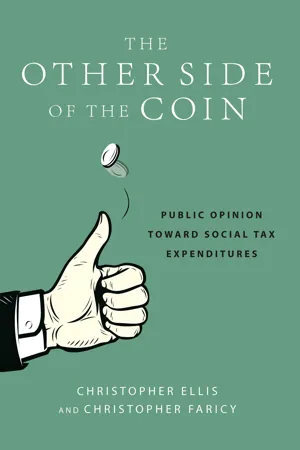
Despite high levels of inequality and wage stagnation over several decades, the United States has done relatively little to address these problems—at least in part due to public opinion, which remains highly influential in determining the size and scope of social welfare programs that provide direct benefits to retirees, unemployed workers or poor families. On the other hand, social tax expenditures—or tax subsidies that help citizens pay for expenses such as health insurance or the cost of college and invest in retirement plans—have been widely and successfully implemented, and they now comprise nearly 40 percent of the spending of the American social welfare state. In The Other Side of the Coin, political scientists Christopher Ellis and Christopher Faricy examine public opinion towards social tax expenditures—the other side of the American social welfare state—and their potential to expand support for such social investment.
Tax expenditures seek to accomplish many of the goals of direct government expenditures, but they distribute money indirectly, through tax refunds or reductions in taxable income, rather than direct payments on goods and services or benefits. They tend to privilege market-based solutions to social problems such as employer-based tax subsidies for purchasing health insurance versus government-provided health insurance. Drawing on nationally representative surveys and survey experiments, Ellis and Faricy show that social welfare policies designed as tax expenditures, as opposed to direct spending on social welfare programs, are widely popular with the general public. Contrary to previous research suggesting that recipients of these subsidies are often unaware of indirect government aid—sometimes called "the hidden welfare state"—Ellis and Faricy find that citizens are well aware of them and act in their economic self-interest in supporting tax breaks for social welfare purposes. The authors find that many people view the beneficiaries of social tax expenditures to be more deserving of government aid than recipients of direct public social programs, indicating that how government benefits are delivered affects people's views of recipients' worthiness. Importantly, tax expenditures are more likely to appeal to citizens with anti-government attitudes, low levels of trust in government, or racial prejudices. As a result, social spending conducted through the tax code is likely to be far more popular than direct government spending on public programs that have the same goals.
The first empirical examination of the broad popularity of tax expenditures, The Other Side of the Coin provides compelling insights into constructing a politically feasible—and potentially bipartisan—way to expand the scope of the American welfare state.
eBook - ePub
The Other Side of the Coin
Public Opinion toward Social Tax Expenditures
- 170 pages
- English
- ePUB (mobile friendly)
- Available on iOS & Android
eBook - ePub
The Other Side of the Coin
Public Opinion toward Social Tax Expenditures
About this book
Information
Table of contents
- Cover Page
- Title Page
- Copyright Page
- Dedication
- Contents
- List of Illustrations
- About the Authors
- Acknowledgments
- Chapter 1. Public Opinion Toward the Hidden Welfare State
- Chapter 2. The Politics of Private Social Welfare
- Chapter 3. Attitudes Toward Social Tax Expenditures
- Chapter 4. Tax Expenditures and Direct Spending: A Comparison
- Chapter 5. Deservingness, Race, and Social Spending
- Chapter 6. The Public and the Private Welfare State
- Notes
- References
- Index
Trusted by 375,005 students
Access to over 1.5 million titles for a fair monthly price.
Study more efficiently using our study tools.
Frequently asked questions
Yes, you can cancel anytime from the Subscription tab in your account settings on the Perlego website. Your subscription will stay active until the end of your current billing period. Learn how to cancel your subscription
No, books cannot be downloaded as external files, such as PDFs, for use outside of Perlego. However, you can download books within the Perlego app for offline reading on mobile or tablet. Learn how to download books offline
Perlego offers two plans: Essential and Complete
- Essential is ideal for learners and professionals who enjoy exploring a wide range of subjects. Access the Essential Library with 800,000+ trusted titles and best-sellers across business, personal growth, and the humanities. Includes unlimited reading time and Standard Read Aloud voice.
- Complete: Perfect for advanced learners and researchers needing full, unrestricted access. Unlock 1.5M+ books across hundreds of subjects, including academic and specialized titles. The Complete Plan also includes advanced features like Premium Read Aloud and Research Assistant.
We are an online textbook subscription service, where you can get access to an entire online library for less than the price of a single book per month. With over 1.5 million books across 990+ topics, we’ve got you covered! Learn about our mission
Look out for the read-aloud symbol on your next book to see if you can listen to it. The read-aloud tool reads text aloud for you, highlighting the text as it is being read. You can pause it, speed it up and slow it down. Learn more about Read Aloud
Yes! You can use the Perlego app on both iOS and Android devices to read anytime, anywhere — even offline. Perfect for commutes or when you’re on the go.
Please note we cannot support devices running on iOS 13 and Android 7 or earlier. Learn more about using the app
Please note we cannot support devices running on iOS 13 and Android 7 or earlier. Learn more about using the app
Yes, you can access The Other Side of the Coin by Christopher G. Faricy,Christopher Ellis in PDF and/or ePUB format, as well as other popular books in Politics & International Relations & Economic Policy. We have over 1.5 million books available in our catalogue for you to explore.