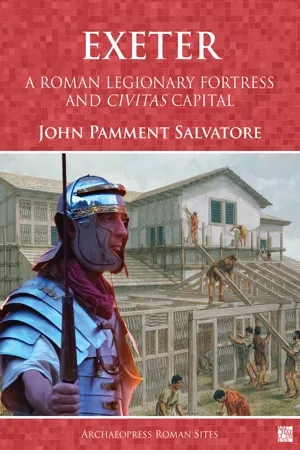
Exeter has long been known as a Roman city, but it was only in 1971 that its origin as a legionary fortress of the mid-first century AD was revealed. That discovery was the result of excavation work undertaken by the first professional archaeological unit to be based in the city. The author was one of those involved and this book explains how innovative archaeological techniques introduced in the 1970s were employed, not only to construct a picture of the legionary fortress, but to demonstrate with some confidence that the 5,000 strong garrison which manned it was the Second Augustan Legion. Whilst at Exeter the legion built its own stone bathhouse. Constructed only around 15-20 years after the Roman invasion in AD 43, it is the earliest known monumental masonry building in the South-West of Britain. Significantly, it was also possible to establish that Exeter became a Roman regional capital around AD 80 after the departure of the legion to Wales. The redundant bathhouse was converted to a basilica (council chamber and administrative centre) for the fledgling city which went on to acquire a circuit of walls by the start of the third century. Exeter continued to flourish as a Roman city on the very western edge of the Roman Empire before its ultimate demise in the late fourth century.
- 179 pages
- English
- PDF
- Available on iOS & Android
eBook - PDF
Exeter: A Roman Legionary Fortress and Civitas Capital
About this book
Information
Subtopic
ArchaeologyIndex
HistoryTable of contents
- Cover
- Title page
- Copyright information
- Dedication
- Contents
- List of Figures
- Author’s Note
- Introduction
- No time to lose (archaeological innovation and discovery at Exeter)
- The Roman army arrives at Exeter
- The Legionary Fortress (and its stone-built bathhouse)
- The purpose of the legionary fortress and its period of occupation
- Extra-mural sites of the prata legionum
- The fortress and its garrison at the time of the Boudican revolt
- Exeter as a Roman town and Civitas Capital
- Late Roman Exeter
- The end of Roman Exeter and the beginning of a new story
- Final Thoughts
- Acknowledgements
- Further reading
- Index
- Back cover
Trusted by 375,005 students
Access to over 1.5 million titles for a fair monthly price.
Study more efficiently using our study tools.
Frequently asked questions
Yes, you can cancel anytime from the Subscription tab in your account settings on the Perlego website. Your subscription will stay active until the end of your current billing period. Learn how to cancel your subscription
No, books cannot be downloaded as external files, such as PDFs, for use outside of Perlego. However, you can download books within the Perlego app for offline reading on mobile or tablet. Learn how to download books offline
Perlego offers two plans: Essential and Complete
- Essential is ideal for learners and professionals who enjoy exploring a wide range of subjects. Access the Essential Library with 800,000+ trusted titles and best-sellers across business, personal growth, and the humanities. Includes unlimited reading time and Standard Read Aloud voice.
- Complete: Perfect for advanced learners and researchers needing full, unrestricted access. Unlock 1.5M+ books across hundreds of subjects, including academic and specialized titles. The Complete Plan also includes advanced features like Premium Read Aloud and Research Assistant.
We are an online textbook subscription service, where you can get access to an entire online library for less than the price of a single book per month. With over 1.5 million books across 990+ topics, we’ve got you covered! Learn about our mission
Look out for the read-aloud symbol on your next book to see if you can listen to it. The read-aloud tool reads text aloud for you, highlighting the text as it is being read. You can pause it, speed it up and slow it down. Learn more about Read Aloud
Yes! You can use the Perlego app on both iOS and Android devices to read anytime, anywhere — even offline. Perfect for commutes or when you’re on the go.
Please note we cannot support devices running on iOS 13 and Android 7 or earlier. Learn more about using the app
Please note we cannot support devices running on iOS 13 and Android 7 or earlier. Learn more about using the app
Yes, you can access Exeter: A Roman Legionary Fortress and Civitas Capital by John Pamment Salvatore in PDF and/or ePUB format, as well as other popular books in History & Archaeology. We have over 1.5 million books available in our catalogue for you to explore.