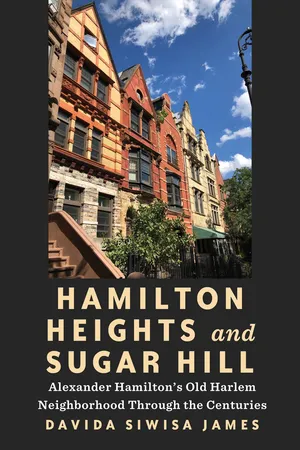
Explores four centuries of colonization, land divisions, and urban development around this historic landmark neighborhood in West Harlem
It was the neighborhood where Alexander Hamilton built his country home, George Gershwin wrote his first hit, a young Norman Rockwell discovered he liked to draw, and Ralph Ellison wrote Invisible Man. Through words and pictures, Hamilton Heights and Sugar Hill traces the transition of this picturesque section of Harlem from lush farmland in the early 1600s to its modern-day growth as a unique Manhattan neighborhood highlighted by stunning architecture, Harlem Renaissance gatherings, and the famous residents who called it home.
Stretching from approximately 135th Street and Edgecombe Avenue to around 165th, all the way to the Hudson River, this small section in the Heights of West Harlem is home to so many significant events, so many extraordinary people, and so much of New York's most stunning architecture, it's hard to believe one place could contain all that majesty. Author Davida Siwisa James brings to compelling literary life the unique residents and dwelling places of this Harlem neighborhood that stands at the heart of the country's founding. Here she uncovers the long-lost history of the transitions to Hamilton Grange in the aftermath of Alexander Hamilton's death and the building boom from about 1885 to 1930 that made it one of Manhattan's most historic and architecturally desirable neighborhoods, now and a century ago. The book also shares the story of the LaGuardia High School of Music & Art, one of the fi rst in the nation to focus on arts and music. The author chronicles the history of the James A. Bailey House, as well as the Morris-Jumel Mansion, Manhattan's oldest surviving residence and famously known as George Washington's headquarters at the start of the American Revolution.
By telling the history of its vibrant people and the beautiful architecture of this lovely, well-maintained historic landmark neighborhood, James also dispels the misconception that Harlem was primarily a ghetto wasteland. The book also touches upon the Great Migration of Blacks leaving the South who landed in Harlem, helping it become the mecca for African Americans, including such Harlem Renaissance artists and luminaries as Thurgood Marshall, Count Basie, Duke Ellington, Mary Lou Williams, Paul Robeson, Regina Anderson Andrews, and W. E. B. Du Bois.