What Do We Mean by That?: Interrogating Familiar Expressions in Education is a collection of essays that opens a space for all educational workers—teachers, teacher educators, administrators, politicians, and others—to unpack commonly used educational phrases and ideas.
The idea is to carefully examine what we say to one another when we talk about schools, curriculum, students, and other educational problems or issues—when we say things like "We have to meet students where they are," and "All children can learn," or "What does the data say?" What Do We Mean by That? challenges and clarifies such phrases and the how, and why, that they shape educational policies and practices.
The influential curricular theorist Dwayne Huebner charged us to always be aware of our "man-made tools," such as language, and said that since "all educators attempt to shape the world; theorists should call attention to the tools used for the shaping in order that the world being shaped can be more beautiful and just."
Language is a tool in educational practice in myriad ways: between administrators and teachers, teachers and students, teachers and parents, and students and students, as examples. A scripted curriculum is a tool intended to provide fixed language to teachers. It is normal for phrases to make their way into our everyday practices and get lodged there. But we need opportunities to interrupt ourselves and study our language tools to ensure they help create beauty and justice.
This collection of thoughtful essays seeks to be this interruption. It is an invaluable tool for improving the educational experience of students and schools.
Perfect for courses such as: Foundations of Education; Curriculum Studies; Diversity in Education; Educational Rhetoric and Policy
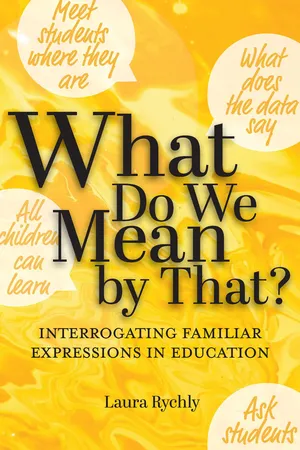
eBook - PDF
What Do We Mean by That?
Interrogating Familiar Expressions in Education
- 187 pages
- English
- PDF
- Available on iOS & Android
eBook - PDF
What Do We Mean by That?
Interrogating Familiar Expressions in Education
About this book
Information
Table of contents
- Cover
- Book Title
- Copyright
- Contents
- Acknowledgments
- Introduction
- ONE Academic Language and Historic Linguicism
- TWO Prior Knowledge
- THREE “Just Be Creative!”
- FOUR hat Do We Truly Mean by Learning Loss?
- FIVE My Kids Can’t Do That!
- SIX “The Community.” What Is It Exactly?
- SEVEN Are We Really Friends? Examining Early Childhood Education’s (ECE’s) (Mis)Use of the Term
- EIGHT What Do We Mean by “Parent Involvement”? Rethinking Home-School Connections
- NINE The Right and the Responsibility: The Paradox “Self-Care” for Teachers and Educators
- TEN Apparently, “Good Teachers” Are Superhuman: Decoding Rhetoric That Perpetuates the “Good Teacher” Ideology
- ELEVEN Do It for the Kids: A Philosophy of Celebration and Coercion
- TWELVE On Diversity, Equity, and Inclusion: What Do You Mean by That?
- THIRTEEN I Don’t See Color. I Just See My Students.
- FOURTEEN A Sticker Does Not A “Safe Space” Make, But You Can Affirm LGBTQ+ People Through Action
- FIFTEEN Interrogating the Digital Divide – Panacea or Panic in the Classroom?
- SIXTEEN “I Just Want My Child To Be Happy”: Examining What We Really Mean by That in the Field of Education Using a Simple Framework for Identifying and Dismantling White Supremacist Patriarchal (WSP) Ideology in Schools and Society
- About the Authors
- Index
Trusted by 375,005 students
Access to over 1.5 million titles for a fair monthly price.
Study more efficiently using our study tools.
Frequently asked questions
Yes, you can cancel anytime from the Subscription tab in your account settings on the Perlego website. Your subscription will stay active until the end of your current billing period. Learn how to cancel your subscription
No, books cannot be downloaded as external files, such as PDFs, for use outside of Perlego. However, you can download books within the Perlego app for offline reading on mobile or tablet. Learn how to download books offline
Perlego offers two plans: Essential and Complete
- Essential is ideal for learners and professionals who enjoy exploring a wide range of subjects. Access the Essential Library with 800,000+ trusted titles and best-sellers across business, personal growth, and the humanities. Includes unlimited reading time and Standard Read Aloud voice.
- Complete: Perfect for advanced learners and researchers needing full, unrestricted access. Unlock 1.5M+ books across hundreds of subjects, including academic and specialized titles. The Complete Plan also includes advanced features like Premium Read Aloud and Research Assistant.
We are an online textbook subscription service, where you can get access to an entire online library for less than the price of a single book per month. With over 1.5 million books across 990+ topics, we’ve got you covered! Learn about our mission
Look out for the read-aloud symbol on your next book to see if you can listen to it. The read-aloud tool reads text aloud for you, highlighting the text as it is being read. You can pause it, speed it up and slow it down. Learn more about Read Aloud
Yes! You can use the Perlego app on both iOS and Android devices to read anytime, anywhere — even offline. Perfect for commutes or when you’re on the go.
Please note we cannot support devices running on iOS 13 and Android 7 or earlier. Learn more about using the app
Please note we cannot support devices running on iOS 13 and Android 7 or earlier. Learn more about using the app
Yes, you can access What Do We Mean by That? by Laura Rychly, Steven P. Jones & Eric C. Sheffield,Laura Rychly in PDF and/or ePUB format, as well as other popular books in Education & Education General. We have over 1.5 million books available in our catalogue for you to explore.