eBook - ePub
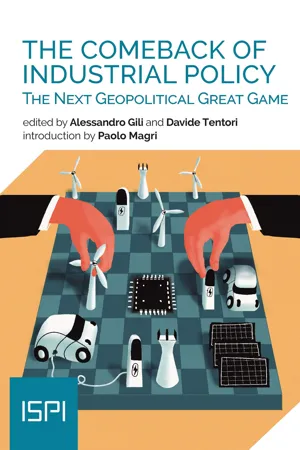
The Comeback of Industrial Policy
The Next Geopolitical Great Game
- English
- ePUB (mobile friendly)
- Available on iOS & Android
eBook - ePub
About this book
Industrial policies are the key element underlying today's geopolitical scramble and a pillar of national security.
Reacting to Western weaknesses and bottlenecks in the global supply chains, highlighted by multiple shocks such as the pandemic, the war in Ukraine, and the recent Israel-Hamas war, the US in first place and the EU later have started to introduce new industrial legislation aimed at making up for lost ground with respect to other industrial
powerhouses, such as China. Besides being policy tools to accelerate the green and digital transitions, however, the US Inflation Reduction Act and the Net Zero Industry Act, as well as the US and the EU Chips Acts, entail subsidies, local content requirements and export controls targeted at strengthening the domestic industrial base for critical technologies, fostering strategic autonomy and de-risking from excessive foreign dependencies.
This race poses risks for the weaponisation of industrial policies and fragmentation of international trade and also potentially jeopardises technological development. How can we strike a balance between economic security and efficiency? Which sectors are the most critical and which ones are the leading global powers pursuing? What will the consequences be for global value chains and international trade? Is it possible to reach an agreement on rules for a new level playing field to prevent economic competition turning into economic warfare?
Information
Table of contents
- The Comeback of Industrial Policy
- Colophon
- Table of Contents
- Introduction
- Mapping Global Value Chains: From Up to Downstream
- Policy Instruments: Setting the Rules of the Game
- The Players: Who’s in the Game
- About the Authors
Trusted by 375,005 students
Access to over 1.5 million titles for a fair monthly price.
Study more efficiently using our study tools.
Frequently asked questions
Yes, you can cancel anytime from the Subscription tab in your account settings on the Perlego website. Your subscription will stay active until the end of your current billing period. Learn how to cancel your subscription
No, books cannot be downloaded as external files, such as PDFs, for use outside of Perlego. However, you can download books within the Perlego app for offline reading on mobile or tablet. Learn how to download books offline
Perlego offers two plans: Essential and Complete
- Essential is ideal for learners and professionals who enjoy exploring a wide range of subjects. Access the Essential Library with 800,000+ trusted titles and best-sellers across business, personal growth, and the humanities. Includes unlimited reading time and Standard Read Aloud voice.
- Complete: Perfect for advanced learners and researchers needing full, unrestricted access. Unlock 1.5M+ books across hundreds of subjects, including academic and specialized titles. The Complete Plan also includes advanced features like Premium Read Aloud and Research Assistant.
We are an online textbook subscription service, where you can get access to an entire online library for less than the price of a single book per month. With over 1.5 million books across 990+ topics, we’ve got you covered! Learn about our mission
Look out for the read-aloud symbol on your next book to see if you can listen to it. The read-aloud tool reads text aloud for you, highlighting the text as it is being read. You can pause it, speed it up and slow it down. Learn more about Read Aloud
Yes! You can use the Perlego app on both iOS and Android devices to read anytime, anywhere — even offline. Perfect for commutes or when you’re on the go.
Please note we cannot support devices running on iOS 13 and Android 7 or earlier. Learn more about using the app
Please note we cannot support devices running on iOS 13 and Android 7 or earlier. Learn more about using the app
Yes, you can access The Comeback of Industrial Policy by Alessandro Gili,Davide Tentori in PDF and/or ePUB format, as well as other popular books in Politics & International Relations & Geopolitics. We have over 1.5 million books available in our catalogue for you to explore.