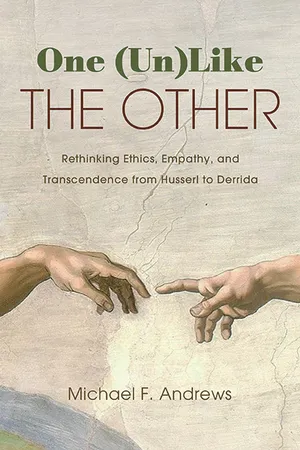
One (Un)Like the Other
eBook - ePub

One (Un)Like the Other

Rethinking Ethics, Empathy, and Transcendence from Husserl to Derrida

  1. 320 pages
  2. English
  3. ePUB (mobile friendly)
  4. Available on iOS & Android
eBook - ePub

One (Un)Like the Other

Rethinking Ethics, Empathy, and Transcendence from Husserl to Derrida

About this book

Aims to rethink ethics and transcendence in light of the phenomenology of empathy and social ontology.

One (Un)Like the Other responds to the question, "What are the conditions of possibility that make genuine knowledge of other persons-and, therefore, love-possible?" By providing an original interpretive framework for exploring ethics in relation to empathy and transcendence from multiple perspectives in continental philosophy, empathy is described as a trace of what remains essentially and irreducibly "other" in every act of givenness. The use of the phenomenological method places "Einfühlung theory" in its rich historical context, beginning with Husserl and the early phenomenologists and extending to contemporary issues that explore "otherness" in light of consciousness, gender, embodiment, community, intentionality, emotions, intersubjectivity, values, language, and apophatic discourse. The implications of recasting "empathy" in an interpretive and dialogical model of reciprocity envision new paradigms of understanding ethics as an infinite playing field. No longer subservient to metaphysics and ontology, empathy is described as an act of infinite concern, a "hermeneutics of suspicion" that transcends epistemological theory and ethical command. Drawing on Husserl, Scheler, Stein, Heidegger, Levinas, Derrida, and others, this study presents an examination and expansion of empathy as an encounter with otherness in its most radical and transcendent forms.

Frequently asked questions

Yes, you can cancel anytime from the Subscription tab in your account settings on the Perlego website. Your subscription will stay active until the end of your current billing period. Learn how to cancel your subscription.
No, books cannot be downloaded as external files, such as PDFs, for use outside of Perlego. However, you can download books within the Perlego app for offline reading on mobile or tablet. Learn more here.
Perlego offers two plans: Essential and Complete
  • Essential is ideal for learners and professionals who enjoy exploring a wide range of subjects. Access the Essential Library with 800,000+ trusted titles and best-sellers across business, personal growth, and the humanities. Includes unlimited reading time and Standard Read Aloud voice.
  • Complete: Perfect for advanced learners and researchers needing full, unrestricted access. Unlock 1.4M+ books across hundreds of subjects, including academic and specialized titles. The Complete Plan also includes advanced features like Premium Read Aloud and Research Assistant.
Both plans are available with monthly, semester, or annual billing cycles.
We are an online textbook subscription service, where you can get access to an entire online library for less than the price of a single book per month. With over 1 million books across 1000+ topics, we’ve got you covered! Learn more here.
Look out for the read-aloud symbol on your next book to see if you can listen to it. The read-aloud tool reads text aloud for you, highlighting the text as it is being read. You can pause it, speed it up and slow it down. Learn more here.
Yes! You can use the Perlego app on both iOS or Android devices to read anytime, anywhere — even offline. Perfect for commutes or when you’re on the go.
Please note we cannot support devices running on iOS 13 and Android 7 or earlier. Learn more about using the app.
Yes, you can access One (Un)Like the Other by Michael F. Andrews in PDF and/or ePUB format, as well as other popular books in Philosophy & Deconstruction in Philosophy. We have over one million books available in our catalogue for you to explore.

Table of contents

  1. Cover
  2. Title
  3. Copyright
  4. Contents
  5. List of Abbreviations
  6. Acknowledgments
  7. Introduction
  8. Part One: Empathy and the Theory of Transcendental Constitution
  9. Part Two: Empathy as Reciprocity
  10. Part Three: A Reversal of the Law of Empathy
  11. Part Four: Ethics, Empathy, and Transcendence
  12. Notes
  13. Selected Bibliography
  14. Index
  15. Back Cover