An innovative examination of the shift by American political parties toward issue-based differentiation
Recent Democratic and Republican party platforms display clear differences on such issues as abortion, LGBTQ+ rights, gun control, and the environment. These distinctions reflect a programmatic party system—that is, one in which policy positions serve as a key basis of electoral competition. Yet party politics were not always so issue-oriented; the rise of policy positions as the dominant marker of party appeal occurred largely over the last fifty years. In Divergent Democracy, Katherine Krimmel examines this transformation of the American party system, using innovative machine learning techniques to develop and present the first measure of party differentiation on issues since Democrats and Republicans began competing with each other in 1856.
Why did the shift to issue-based party competition take more than a century to materialize? Krimmel offers a groundbreaking theory, focusing on what aids and constrains parties’ abilities to do the difficult, conflict-ridden work of developing issue positions. She argues that clientelistic subnational party organizations, promising material support or jobs in return for votes, long impeded programmatic partisanship while the growth of national party organizations facilitated it. Moreover, institutions and agents of racial oppression extended the life of nonprogrammatic practices, as they attempted to shield discriminatory laws and institutions from interparty competition. Following the civil rights revolution of the 1960s, space opened for programmatic competition to grow.
Using both quantitative and qualitative tools, Krimmel offers a vital view of the foundations of today’s issue-based party competition and its alternatives.
eBook - ePub
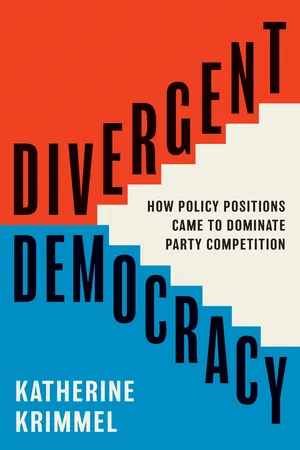
Divergent Democracy
How Policy Positions Came to Dominate Party Competition
- 296 pages
- English
- ePUB (mobile friendly)
- Available on iOS & Android
eBook - ePub
About this book
Information
Publisher
Princeton University PressYear
2024Print ISBN
9780691257969
9780691257952
eBook ISBN
9780691258065
Table of contents
- Cover Page
- Series Page
- Title Page
- Copyright Page
- Dedication
- Contents
- List of Figures
- List of Tables
- Preface
- Acknowledgments
- Abbreviations
- 1. The Puzzle of Programmatic Partisanship
- 2. What Constrains and Facilitates Programmaticism?
- 3. The Dance of Clientelism and Programmaticism
- 4. National Party Institutions and Programmaticism, 1856–1950
- 5. National Party Institutions and Programmaticism, 1950–2020
- 6. Party Competition and American Democracy
- Appendix
- Notes
- Bibliography
- Index
- Series List
Trusted by 375,005 students
Access to over 1.5 million titles for a fair monthly price.
Study more efficiently using our study tools.
Frequently asked questions
Yes, you can cancel anytime from the Subscription tab in your account settings on the Perlego website. Your subscription will stay active until the end of your current billing period. Learn how to cancel your subscription
No, books cannot be downloaded as external files, such as PDFs, for use outside of Perlego. However, you can download books within the Perlego app for offline reading on mobile or tablet. Learn how to download books offline
Perlego offers two plans: Essential and Complete
- Essential is ideal for learners and professionals who enjoy exploring a wide range of subjects. Access the Essential Library with 800,000+ trusted titles and best-sellers across business, personal growth, and the humanities. Includes unlimited reading time and Standard Read Aloud voice.
- Complete: Perfect for advanced learners and researchers needing full, unrestricted access. Unlock 1.5M+ books across hundreds of subjects, including academic and specialized titles. The Complete Plan also includes advanced features like Premium Read Aloud and Research Assistant.
We are an online textbook subscription service, where you can get access to an entire online library for less than the price of a single book per month. With over 1.5 million books across 990+ topics, we’ve got you covered! Learn about our mission
Look out for the read-aloud symbol on your next book to see if you can listen to it. The read-aloud tool reads text aloud for you, highlighting the text as it is being read. You can pause it, speed it up and slow it down. Learn more about Read Aloud
Yes! You can use the Perlego app on both iOS and Android devices to read anytime, anywhere — even offline. Perfect for commutes or when you’re on the go.
Please note we cannot support devices running on iOS 13 and Android 7 or earlier. Learn more about using the app
Please note we cannot support devices running on iOS 13 and Android 7 or earlier. Learn more about using the app
Yes, you can access Divergent Democracy by Katherine Krimmel in PDF and/or ePUB format, as well as other popular books in Politics & International Relations & American Government. We have over 1.5 million books available in our catalogue for you to explore.