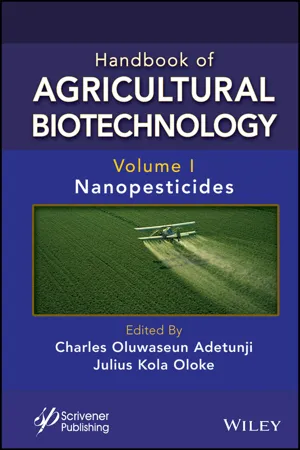
Handbook of Agricultural Biotechnology, Volume 1
Nanopesticides
- English
- ePUB (mobile friendly)
- Available on iOS & Android
Handbook of Agricultural Biotechnology, Volume 1
Nanopesticides
About this book
Handbook of AGRICULTURAL BIOTECHNOLOGY
The book provides detailed information on the application of nanopesticides for the management of numerous agricultural pests and pathogens, as well as to foster an innovative pathway toward future sustainable agriculture and food systems.
Biopesticides have been identified as a sustainable and permanent replacement to synthetic chemicals. Their application will go a long way toward preventing major challenges that confront sustainable agriculture, the actualization of global food production and food security, helping to feed an ever-increasing population that is predicted to increase to nine billion by 2050. An interdisciplinary collaboration among policymakers, private sector, researchers, civil society, farmers, consumers, and environmentalists will foster an innovative pathway toward future sustainable agriculture and food systems that could ensure resilience, food security, and a healthy environment.
The book explains the application of some nanobiopesticides as ovicides that could kill eggs of insects and mites, as well as slimicides that could destroy slime-producing microorganisms, such as algae, bacteria, fungi, and slime molds. Other highlights include: a discussion on the application of nanobiopesticides for the rejuvenation of heavily contaminated environments (as well as their role in the mitigation of several abiotic stress); a demonstration of how nanobiopesticides derived from plants could be applied for effective management of pests and diseases in animal husbandry and fishery; and a collection of relevant information on patents, the commercialization of relevant plant-derived nanobiopesticides, and their social economic and industrial relevance.
Audience
The book is a useful resource for a diverse audience, including industrialists, food industry professionals, agriculturists, agricultural microbiologists, plant pathologists, botanists, microbiologists, biotechnologists, nanotechnologists, microbial biotechnologists, farmers, policymakers, and extension workers.
Frequently asked questions
- Essential is ideal for learners and professionals who enjoy exploring a wide range of subjects. Access the Essential Library with 800,000+ trusted titles and best-sellers across business, personal growth, and the humanities. Includes unlimited reading time and Standard Read Aloud voice.
- Complete: Perfect for advanced learners and researchers needing full, unrestricted access. Unlock 1.4M+ books across hundreds of subjects, including academic and specialized titles. The Complete Plan also includes advanced features like Premium Read Aloud and Research Assistant.
Please note we cannot support devices running on iOS 13 and Android 7 or earlier. Learn more about using the app.
Information
Table of contents
- Cover
- Table of Contents
- Series Page
- Title Page
- Copyright Page
- Preface
- 1 Application Nanobiopesticides Derived From Plants
- 2 Application of Plant-Based Nanobiopesticides That Could Be Applied as Fumigants
- 3 Application of Plant-Based Nanobiopesticides as Biocides
- 4 Application of Plant-Based Nanobiopesticides as Disinfectant
- 5 Application of Plant-Based Nanobiopesticides as Sanitizers
- 6 Application of Plant-Based Nanobiopesticides Slimicides Against Slime-Producing Microorganisms
- 7 Application of Plant-Based Nanobiopesticides That Could Be Applied for the Rejuvenation of Heavily Contaminated Environments
- 8 Application of Plant-Based Nanobiopesticides for Effective Management of Pests and Diseases in Animal Husbandry
- 9 Application of Plant-Based Nanobiopesticides for Mitigation of Several Biotic Stress
- 10 The Influence of Nanopesticides on the Social Economy, Its Bioeconomy Perspectives in Attaining Sustainable Development Goals
- 11 Application of Nanotechnology for the Production of Biopesticides, Bioinsecticides, Bioherbicides, Mosquitoe Repellants and Biofungicides
- 12 Relevance of Nanomaterials Derived From Medicinal Plants for Marine and Terrestrial Environments: Recent Advances
- 13 Biological Activities of Nanomaterials From Biogenic Source for the Treatment of Diseases and Its Role in Regenerative and Tissue Engineering
- 14 Application of Plant-Based Nanobiopesticides for Mitigation of Several Abiotic Stress
- Index
- Also of Interest
- End User License Agreement