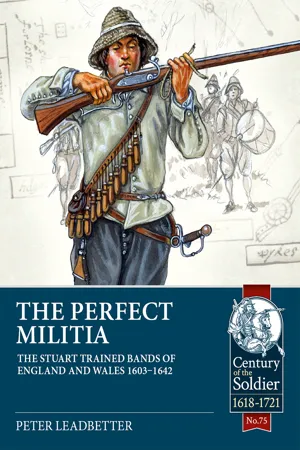
This book covers an important part of British military history, namely the Trained Bands of the early Stuart period, 1603 - 1642. Both James I and Charles I tried to create a perfect militia during their reigns but how far did they get in achieving this aim? There is very little published about this organization. This book includes details on the men who served in it, how they were recruited, their social status, professions, and ages. The soldiers were mustered for training at least once a year at county or regimental level, but were they mustered and trained more often at a local level? And, if so, how often? There were different categories of soldiers in the Trained Bands; these categories were not just designated by the arm of service or by the arms they carried, but also by who had provided (and paid for) them. The arms and armor used by the soldiers changed over the period covered by this book and descriptions of these are included. Did the men of the Trained Band wear uniforms? Who were the officers who commanded the companies and regiments and how were they appointed? This book aims not only to answer these questions, but also to enlighten the reader on many other aspects of this important organization. Defense always costs money, and this was especially true of the Trained Bands. Men and muster-masters had to be paid and fed; powder and match bought for training; new arms and armor sourced. All these needed money - money that was in many cases only grudgingly given. The methods of raising this money were varied and in the main seem to have worked. Relations between the counties and the government in London are also covered. The government's requests or requirements were not always well received; many people in the counties did not like being given orders from London, a place they believed to have little interest in what was happening locally. The Trained Bands were not put to the test of battle prior to the Civil War, although they had come close in the Bishops' Wars; but they proved reluctant to act against ordinary people during protests about perceived or actual local grievances. One of the biggest questions that could be asked of the Trained Bands is: "in the face of an external enemy, would they have fought and would they have stood firm?" Against an enemy which would almost certainly have been experienced and battle-hardened.
eBook - ePub
The Perfect Militia
The Stuart Trained Bands of England and Wales 1603-1642
- 178 pages
- English
- ePUB (mobile friendly)
- Available on iOS & Android
eBook - ePub
About this book
Information
Subtopic
British HistoryIndex
HistoryTable of contents
- Cover
- Title
- Copyright
- Contents
- Introduction
- Author’s Note: Drill Manuals
- 1. The Stuart Trained Bands of England and Wales, 1603-1642
- 2. The Regimental and Company Organisations for the Trained Bands Foot and Horse
- 3. The Officers and the Soldiers in the Trained Bands
- 4. The Musters
- 5. The System and the Problems
- 6. Effectiveness
- 7. Uniforms, Ribbons and Colours
- 8. Arms, Armour and Equipment
- Appendix I: A Captain’s Commission
- Appendix II: An Oath of a Chief Constable
- Appendix III: A Drummer’s Warrant, 1636
- Appendix IV: Captain Ashenhurst’s Warrant, Essex
- Appendix V: Training Manual, Derbyshire
- Appendix VI: Training Manual, Hampshire
- Appendix VII: The Deputy Lieutenants of Yorkshire
- Appendix VIII: The Oaths of Allegiance and Supremacy
- Appendix IX: Fairies and Devils
- Bibliography
Trusted by 375,005 students
Access to over 1.5 million titles for a fair monthly price.
Study more efficiently using our study tools.
Frequently asked questions
Yes, you can cancel anytime from the Subscription tab in your account settings on the Perlego website. Your subscription will stay active until the end of your current billing period. Learn how to cancel your subscription
No, books cannot be downloaded as external files, such as PDFs, for use outside of Perlego. However, you can download books within the Perlego app for offline reading on mobile or tablet. Learn how to download books offline
Perlego offers two plans: Essential and Complete
- Essential is ideal for learners and professionals who enjoy exploring a wide range of subjects. Access the Essential Library with 800,000+ trusted titles and best-sellers across business, personal growth, and the humanities. Includes unlimited reading time and Standard Read Aloud voice.
- Complete: Perfect for advanced learners and researchers needing full, unrestricted access. Unlock 1.5M+ books across hundreds of subjects, including academic and specialized titles. The Complete Plan also includes advanced features like Premium Read Aloud and Research Assistant.
We are an online textbook subscription service, where you can get access to an entire online library for less than the price of a single book per month. With over 1.5 million books across 990+ topics, we’ve got you covered! Learn about our mission
Look out for the read-aloud symbol on your next book to see if you can listen to it. The read-aloud tool reads text aloud for you, highlighting the text as it is being read. You can pause it, speed it up and slow it down. Learn more about Read Aloud
Yes! You can use the Perlego app on both iOS and Android devices to read anytime, anywhere — even offline. Perfect for commutes or when you’re on the go.
Please note we cannot support devices running on iOS 13 and Android 7 or earlier. Learn more about using the app
Please note we cannot support devices running on iOS 13 and Android 7 or earlier. Learn more about using the app
Yes, you can access The Perfect Militia by Peter Leadbetter in PDF and/or ePUB format, as well as other popular books in History & British History. We have over 1.5 million books available in our catalogue for you to explore.