The Arab-Israeli conflict persisted through two wars and ongoing border tensions. However, the Six-Day War of June 1967 was a cataclysm. Israel emerged victorious in a war with neighboring Arab states and in possession of occupied territory. The Arabs were furious at this outcome and determined to regain their lands and dignity by again making war with Israel. Added to the mix was a resurgent Palestinian liberation movement. Renewed fighting began within weeks. It became a period of sustained combat, casualties, fiscal outlay, and diplomacy on the world stage unlike anything experienced previously. All involved militaries remained very active over these years with more consistent mobilization, intensive training, and action than ever before. Each side deepened their dependence on superpower arms supply. The geopolitical stakes rose and Israel found itself fighting the Soviets indirectly on the borders and terrorist internationally. Adversary forces grew in size, adopted more complex weapons, and trained in new tactics, all in the tumult of combat of escalating intensity. The air forces of especially Israel and Egypt, then Syria, became especially active, growing in size and capabilities. They employed some of the most advanced weapons the USA and the USSR arrayed in their Cold War confrontation. The extent of the air war grew to extensive air defenses and long-range bombing plus deep photo reconnaissance. The danger of this sparking another general war with potential superpower involvement was high. This period is collectively referred to as the War of Attrition. The named War of Attrition on the Suez Canal began on 8 March 1969 and ended with a cease fire 17 months later. However, combat beyond this area began even before this period and extended beyond. Volume 3 focuses initially on the fighting across the Jordan River. This eventually led to a civil war in Jordan and battles between Jordanian and Syrian armored forces. Syria began more actively challenging Israeli occupation of the Golan Heights in summer 1970 and this grew over the next two years to almost periodic combat of increasing severity. The border with Lebanon also heated up with Palestinian attacks and Israeli responses that included a growing number of cross-border incursions and bombing. This brought Syrian reactions and pushed Lebanon towards anarchy. Tensions persisted on the southern front and the Palestinians took their struggle outside the region with a campaign of international terrorism. Both Egypt and Syria prepared to launch a war to liberate their occupied territories with little warning. It was an extraordinary time of confrontation, irregular warfare, rising terrorism, and national struggles seldom seen before or since. It became the world's most violent, costly, and dangerous conflict after that in Southeast Asia. At the center of it, Israel found herself engaged on all sides and isolated as never before. The struggle altered the geopolitical landscape and set the stage for the October 1973 war. Richly illustrated with photographs, maps, charts and tables, the reader will find new details and correction of previously published 'facts.' This is the most focused and clear account of these Arab-Israeli confrontation events.
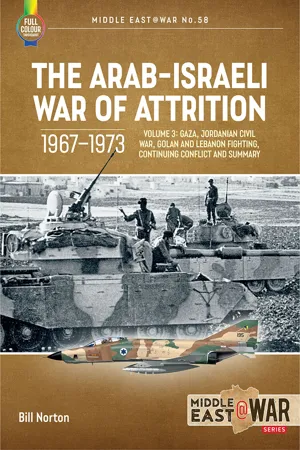
eBook - ePub
The Arab–Israeli War of Attrition, 1967–1973
Volume 3: Gaza, Jordanian Civil War, Golan and Lebanon Fighting, Continuing Conflict and Summary
- 104 pages
- English
- ePUB (mobile friendly)
- Available on iOS & Android
eBook - ePub
The Arab–Israeli War of Attrition, 1967–1973
Volume 3: Gaza, Jordanian Civil War, Golan and Lebanon Fighting, Continuing Conflict and Summary
About this book
Information
Subtopic
20th Century HistoryIndex
HistoryTable of contents
- Cover
- Contents
- Copyright
- Acronyms and Abbreviations
- Foreword and Acknowledgements
- 1 Gaza Strip Hotbed
- 2 Jordanian Civil War
- 3 Fighting in the North
- 4 Continuing Conflict
- 5 Armed Camps
- 6 After-Action Report
- Appendices
- Bibliography
- Further Reading
- Endnotes
- About the Author
- Plates
Trusted by 375,005 students
Access to over 1.5 million titles for a fair monthly price.
Study more efficiently using our study tools.
Frequently asked questions
Yes, you can cancel anytime from the Subscription tab in your account settings on the Perlego website. Your subscription will stay active until the end of your current billing period. Learn how to cancel your subscription
No, books cannot be downloaded as external files, such as PDFs, for use outside of Perlego. However, you can download books within the Perlego app for offline reading on mobile or tablet. Learn how to download books offline
Perlego offers two plans: Essential and Complete
- Essential is ideal for learners and professionals who enjoy exploring a wide range of subjects. Access the Essential Library with 800,000+ trusted titles and best-sellers across business, personal growth, and the humanities. Includes unlimited reading time and Standard Read Aloud voice.
- Complete: Perfect for advanced learners and researchers needing full, unrestricted access. Unlock 1.5M+ books across hundreds of subjects, including academic and specialized titles. The Complete Plan also includes advanced features like Premium Read Aloud and Research Assistant.
We are an online textbook subscription service, where you can get access to an entire online library for less than the price of a single book per month. With over 1.5 million books across 990+ topics, we’ve got you covered! Learn about our mission
Look out for the read-aloud symbol on your next book to see if you can listen to it. The read-aloud tool reads text aloud for you, highlighting the text as it is being read. You can pause it, speed it up and slow it down. Learn more about Read Aloud
Yes! You can use the Perlego app on both iOS and Android devices to read anytime, anywhere — even offline. Perfect for commutes or when you’re on the go.
Please note we cannot support devices running on iOS 13 and Android 7 or earlier. Learn more about using the app
Please note we cannot support devices running on iOS 13 and Android 7 or earlier. Learn more about using the app
Yes, you can access The Arab–Israeli War of Attrition, 1967–1973 by Bill Norton in PDF and/or ePUB format, as well as other popular books in History & 20th Century History. We have over 1.5 million books available in our catalogue for you to explore.