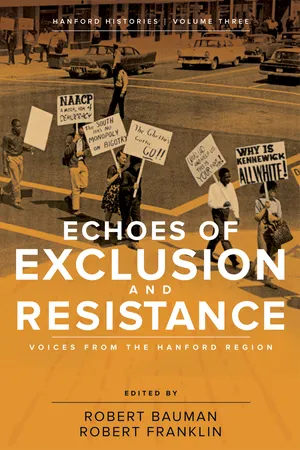
Echoes of Exclusion and Resistance
Voices from the Hanford Region
- 274 pages
- English
- ePUB (mobile friendly)
- Available on iOS & Android
Echoes of Exclusion and Resistance
Voices from the Hanford Region
About this book
Like the rest of the American West, the mid-Columbia region has always been diverse. Its history mirrors common multiracial narratives, but with important nuances. In the late 1880s, Chinese railroad workers were segregated to East Pasco, a practice that later extended to all non-whites and continued for decades. Kennewick residents became openly proud of their status as a "lily-white" town.
In Echoes of Exclusion and Resistance, the third Hanford Histories volume, four scholars--Laura Arata, Robert Bauman, Robert Franklin, and Thomas E. Marceau--draw from Hanford History Project, Atomic Heritage Foundation, and Afro-American Community Cultural and Educational Society oral histories to focus on the experiences of non-white groups whose lives were deeply impacted by the Hanford Site. Linked in ways they likely could not know, each group resisted the segregation and discrimination they encountered, and in the process, challenged the region's dominant racial norms.
The Wanapum, evicted by Hanford Nuclear Reservation construction, relate stories of their people, as well as their responses to dislocation and forced evacuation. Unable to interact with the ancient landscapes and utilize the natural resources of their traditional lands, they suffered painful, irretrievable losses. Early arrivals to the town of Pasco, the Yamauchi family built the American dream--including successful businesses and highly educated children--only to have their aspirations crushed by World War II Japanese-American internment. Thousands of African Americans migrated to the area for wartime jobs and discovered rampant segregation. Through negotiations, demonstrations, and protests, they fought the region's ingrained racial disparity. During the early years of the Cold War, Black women, mostly from East Texas, also relocated to work at Hanford. They offer a unique perspective on employment, discrimination, family, and faith.
Frequently asked questions
- Essential is ideal for learners and professionals who enjoy exploring a wide range of subjects. Access the Essential Library with 800,000+ trusted titles and best-sellers across business, personal growth, and the humanities. Includes unlimited reading time and Standard Read Aloud voice.
- Complete: Perfect for advanced learners and researchers needing full, unrestricted access. Unlock 1.4M+ books across hundreds of subjects, including academic and specialized titles. The Complete Plan also includes advanced features like Premium Read Aloud and Research Assistant.
Please note we cannot support devices running on iOS 13 and Android 7 or earlier. Learn more about using the app.
Information
Table of contents
- Cover
- Halftitle
- Title
- Copyright
- Contents
- Illustrations
- Acknowledgments
- Abbreviations
- Introduction: The Four Deaths of Henry Williams: Constructing Racial Narratives in the Tri-Cities Robert Bauman
- 1. The Ties That Bind: Hanfordâs Ancient Landscape and Contemporary Native Americans Thomas E. Marceau
- 2. âWhat is an American?â: The Yamauchi Family, Race, and Citizenship in World War II Tri-Cities Robert Bauman
- 3. âI Chose East Pasco Because I Didnât Have No Other Choiceâ: African American Migration, Segregation, and Civil Rights at Hanford and the Tri-Cities, 1943â1960 Robert Franklin
- 4. âTo Better My Conditionâ: African American Women in the Tri-Cities, 1940â1970 Laura J. Arata
- 5. âThe Birmingham of Washingtonâ: Civil Rights and Black Power in the Tri-Cities Robert Bauman and Robert Franklin
- 6. Latino/as and the Continuing Significance of Race in the Tri-Cities Robert Bauman and Robert Franklin
- Appendix: Oral History Interviews
- Ellenor Moore
- Wallace (Wally) Webster
- Contributors
- Bibliography
- Index