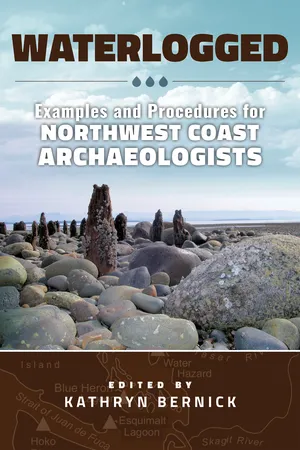
On the Northwest Coast in antiquity, an estimated 85 percent of objects were made entirely from materials that normally do not survive the ravages of time. Fortunately, the region's wetlands, silt-laden rivers, high groundwater levels, and abundant rainfall provide ideal conditions for long-term preservation of waterlogged wood. Few archaeologists intentionally search for them, yet every Northwest Coast archaeologist may encounter waterlogged cultural remains--even inland, away from the coast. Those who investigate can uncover artifacts, structures, and environmental remains missing from the usual reconstructions of past lifeways.
Currently, wet-site archaeology is not widely taught at North American universities. Waterlogged helps bridge that gap. Sixteen archaeologists who work on the Northwest Coast discuss their research in regional and global perspectives, share highlights of their findings, provide guidance on how to locate wet sites, and outline procedures for recovering and caring for perishable waterlogged artifacts. The volume offers practical information about logistics, equipment, and supplies, including a wet-site field kit list.
Waterlogged presents previously unpublished original research spanning the past ten thousand years of human presence on the Northwest Coast. Examples include the first fish trap features in the region to be identified as longshore weirs, a complete 750-year-old basket cradle from the lower Fraser Valley, wooden self-armed fishhooks from the Salish Sea, and a paleoethnobotanical study at the 10,500-year-old Kilgii Gwaay wet site on Haida Gwaii. Contributors also discuss insider-vs.-outsider perceptions of wetlands in Cowichan traditional territory on Vancouver Island, a habitation site in a disappearing wetland in the Fraser Valley, a collaborative project on the Babine River in the Fraser Plateau, and Early and Middle Holocene waterlogged materials from British Columbia's central coast.