eBook - ePub
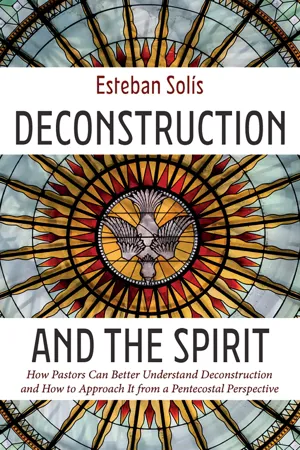
Deconstruction and the Spirit
How Pastors Can Better Understand Deconstruction and How to Approach It from a Pentecostal Perspective
- 142 pages
- English
- ePUB (mobile friendly)
- Available on iOS & Android
eBook - ePub
Deconstruction and the Spirit
How Pastors Can Better Understand Deconstruction and How to Approach It from a Pentecostal Perspective
About this book
Deconstructive faith experiences are growing in number throughout global Christianity. Factors like globalization, individualism, education, post-colonial experiences, fundamentalism, connectivity, and others contribute to accelerate this trend and shape the environment of faith communities that find themselves amongst increasingly postmodern tendencies. Many pastors are deciding to ignore the situation by rejecting deconstruction altogether, while others are embracing it blindly. Since an overwhelming number of churches worldwide embrace Pentecostalism, Esteban Solis proposes a pastoral response from a distinctively Pentecostal perspective that engages deconstruction of faith critically while staying open to conceive it as a tool for Spirit-led discipleship that can produce a more mature faith.
The book examines six affirmations made by Jacques Derrida that explain deconstruction. Each of these is contrasted with specific examples of cultural changes taking place in Costa Rica, Peter's experience at the house of Cornelius, and a Pentecostal perspective.
By exploring a variety of authors, Solis identifies different tools that can help pastors to better understand the experience of deconstruction while engaging in discipleship practices that can produce mature believers in a postmodern era.
Information
Topic
Theology & ReligionSubtopic
Deconstruction in PhilosophyTable of contents
- Title Page
- Chapter 1: Postmodernism and the Global South
- Chapter 2: Deconstruction Happens
- Chapter 3: Deconstruction Happens from Inside
- Chapter 4: Deconstruction Is Not a Method
- Chapter 5: Deconstruction Is a Call
- Chapter 6: Deconstruction Is a “Yes” to the Other
- Chapter 7: Deconstruction Is Affirmative of Institutions. . . Is Not Destruction
- Chapter 8: What Is Going On?
- Chapter 9: Why Is This Going On?
- Chapter 10: What Ought to Be Going On?
- Chapter 11: How Might We Respond?
- A Word of Advice
- Bibliography
Trusted by 375,005 students
Access to over 1.5 million titles for a fair monthly price.
Study more efficiently using our study tools.
Frequently asked questions
Yes, you can cancel anytime from the Subscription tab in your account settings on the Perlego website. Your subscription will stay active until the end of your current billing period. Learn how to cancel your subscription
No, books cannot be downloaded as external files, such as PDFs, for use outside of Perlego. However, you can download books within the Perlego app for offline reading on mobile or tablet. Learn how to download books offline
Perlego offers two plans: Essential and Complete
- Essential is ideal for learners and professionals who enjoy exploring a wide range of subjects. Access the Essential Library with 800,000+ trusted titles and best-sellers across business, personal growth, and the humanities. Includes unlimited reading time and Standard Read Aloud voice.
- Complete: Perfect for advanced learners and researchers needing full, unrestricted access. Unlock 1.5M+ books across hundreds of subjects, including academic and specialized titles. The Complete Plan also includes advanced features like Premium Read Aloud and Research Assistant.
We are an online textbook subscription service, where you can get access to an entire online library for less than the price of a single book per month. With over 1.5 million books across 990+ topics, we’ve got you covered! Learn about our mission
Look out for the read-aloud symbol on your next book to see if you can listen to it. The read-aloud tool reads text aloud for you, highlighting the text as it is being read. You can pause it, speed it up and slow it down. Learn more about Read Aloud
Yes! You can use the Perlego app on both iOS and Android devices to read anytime, anywhere — even offline. Perfect for commutes or when you’re on the go.
Please note we cannot support devices running on iOS 13 and Android 7 or earlier. Learn more about using the app
Please note we cannot support devices running on iOS 13 and Android 7 or earlier. Learn more about using the app
Yes, you can access Deconstruction and the Spirit by Esteban Solís in PDF and/or ePUB format, as well as other popular books in Theology & Religion & Deconstruction in Philosophy. We have over 1.5 million books available in our catalogue for you to explore.