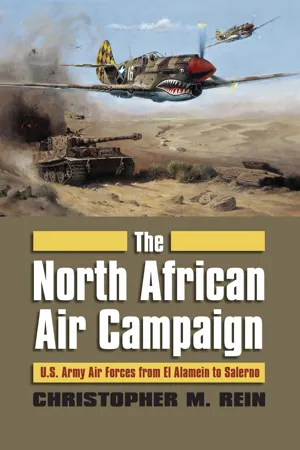
In the summer of 1942, Axis forces controlled almost the entire southern shore of the Mediterranean. Less than a year later, they had been swept from the African continent-thanks in no small part to efforts of the fledgling U.S. Army Air Force. Indeed, USAAF in North Africa emerged as a senior partner in the Alliance, supplying aircraft and crews at a rate the other partners were unable to match.
Going beyond the spare analysis of North African air operations in previous accounts, Christopher Rein shows how American fighter planes and heavy bombers, employed in almost exclusively tactical and operational roles, played a pivotal role in the Alliance’s successful ground campaigns. This aerial armada also had a significant negative impact on enemy logistics through its bombing raids on Axis ports, shipping, and airfields. In the process, USAAF helped foster and develop a pattern of inter-service cooperation that remains at the foundation of American close-air-support doctrine today.
Rein chronicles the emergence of USAAF in the late interwar and early WWII periods as a more heterogeneous and creative fighting force than earlier works have led us to believe. He then analyzes little-known aspects of the war, including early air operations in the eastern Mediterranean and in the TORCH landings. He explores some of the key issues confronting Eisenhower, such as how to establish USAAF priorities and how to deploy long-range bombers, fighters, and attack forces. In describing the struggle for balance in the employment of air assets between strategic bombing and interdiction in a time fraught with inter-service rivalry, he shows how, despite occasional mistakes such as the heavy losses involved in the Ploesti raids, USAAF struck a suitable balance and even invested more assets in interdiction than traditional accounts of strategic bombardment would suggest.
A virtual operational-level history of the USAAF during the formative period of American airpower, Rein’s account pulls together material from diverse sources to demonstrate that today’s Air Force emphasis on mobility, intelligence, reconnaissance, and close support for ground forces have deep roots. By showing that the Army Air Force in World War II did not neglect support for ground and naval forces in order to concentrate exclusively on strategic bombing, it suggests lessons for military and civilian leaders in the employment of air forces in current and future conflicts.