A breathtakingly illustrated look at botanical spirals and the scientists who puzzled over them
Charles Darwin was driven to distraction by plant spirals, growing so exasperated that he once begged a friend to explain the mystery “if you wish to save me from a miserable death.” The legendary naturalist was hardly alone in feeling tormented by these patterns. Plant spirals captured the gaze of Leonardo da Vinci and became Alan Turing’s final obsession. This book tells the stories of the physicists, mathematicians, and biologists who found themselves magnetically drawn to Fibonacci spirals in plants, seeking an answer to why these beautiful and seductive patterns occur in botanical forms as diverse as pine cones, cabbages, and sunflowers.
Do Plants Know Math? takes you down through the centuries to explore how great minds have been captivated and mystified by Fibonacci patterns in nature. It presents a powerful new geometrical solution, little known outside of scientific circles, that sheds light on why regular and irregular spiral patterns occur. Along the way, the book discusses related plant geometries such as fractals and the fascinating way that leaves are folded inside of buds. Your neurons will crackle as you begin to see the connections. This book will inspire you to look at botanical patterns—and the natural world itself—with new eyes.
Featuring hundreds of gorgeous color images, Do Plants Know Math? includes a dozen creative hands-on activities and even spiral-plant recipes, encouraging readers to explore and celebrate these beguiling patterns for themselves.
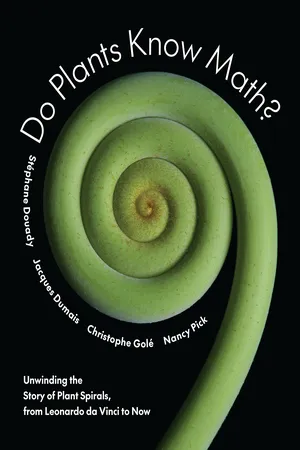
eBook - ePub
Do Plants Know Math?
Unwinding the Story of Plant Spirals, from Leonardo da Vinci to Now
- 352 pages
- English
- ePUB (mobile friendly)
- Available on iOS & Android
eBook - ePub
Do Plants Know Math?
Unwinding the Story of Plant Spirals, from Leonardo da Vinci to Now
About this book
Information
Table of contents
- Cover Page
- Frontispiece
- Title Page
- Copyright Page
- Epigraphs
- Dedication
- Contents
- Preface
- Introduction
- Part I: Who Noticed First?
- Part II: Could Early Scientists Explain Plant Spirals?
- Part III: What Did the Microscope Reveal?
- Part IV: Have Computers Shed Any Light?
- Part V: What Do Biologists Think?
- Part VI: Conclusion
- Appendix
- Notes
- Illustration Credits
- Acknowledgents
- Index
Trusted by 375,005 students
Access to over 1.5 million titles for a fair monthly price.
Study more efficiently using our study tools.
Frequently asked questions
Yes, you can cancel anytime from the Subscription tab in your account settings on the Perlego website. Your subscription will stay active until the end of your current billing period. Learn how to cancel your subscription
No, books cannot be downloaded as external files, such as PDFs, for use outside of Perlego. However, you can download books within the Perlego app for offline reading on mobile or tablet. Learn how to download books offline
Perlego offers two plans: Essential and Complete
- Essential is ideal for learners and professionals who enjoy exploring a wide range of subjects. Access the Essential Library with 800,000+ trusted titles and best-sellers across business, personal growth, and the humanities. Includes unlimited reading time and Standard Read Aloud voice.
- Complete: Perfect for advanced learners and researchers needing full, unrestricted access. Unlock 1.5M+ books across hundreds of subjects, including academic and specialized titles. The Complete Plan also includes advanced features like Premium Read Aloud and Research Assistant.
We are an online textbook subscription service, where you can get access to an entire online library for less than the price of a single book per month. With over 1.5 million books across 990+ topics, we’ve got you covered! Learn about our mission
Look out for the read-aloud symbol on your next book to see if you can listen to it. The read-aloud tool reads text aloud for you, highlighting the text as it is being read. You can pause it, speed it up and slow it down. Learn more about Read Aloud
Yes! You can use the Perlego app on both iOS and Android devices to read anytime, anywhere — even offline. Perfect for commutes or when you’re on the go.
Please note we cannot support devices running on iOS 13 and Android 7 or earlier. Learn more about using the app
Please note we cannot support devices running on iOS 13 and Android 7 or earlier. Learn more about using the app
Yes, you can access Do Plants Know Math? by Stéphane Douady,Jacques Dumais,Christophe Golé,Nancy Pick in PDF and/or ePUB format, as well as other popular books in Mathematics & Geometry. We have over 1.5 million books available in our catalogue for you to explore.