This study focuses on the fabric, construction and preservation of stretches of Hadrian's Wall in its more remote locations, providing significant insights into the places between the mile castles and important forts and associated settlements.
The Hadrian’s Wall Community Archaeology Project (WallCAP) conducted a series of fieldwork projects along the Hadrian’s Wall corridor between 2019 and 2021. The work focused on sites that were poorly understood or under particular threat and aimed to improve understanding of them so they could be better managed in future. At several sites excavation was followed by conservation and consolidation work.This volume brings together the final reports of these excavations, at six Roman sites in the Wall corridor. As the sites were spread along the length of the Wall the character and afterlife of the Wall in very different landscape locations could be compared. An assessment of the Vallum at Heddon on the Wall identified how earthwork archaeology survived in a sloped, heavily ploughed landscape. Three excavations investigated the condition of the stone Wall curtain: at Port Carlisle, Walltown Crags, and Steel Rigg and Cats Stairs. At each site the Wall builders had responded to the demands of the local terrain and made use of local resources. At each site the Wall had a different post-Roman history. Excavations at the bridging point of the Cam Beck revealed for the first time how the Wall was carried over a ‘minor’ watercourse, and discovered traces of the Turf Wall. Small buildings were also identified just south of the Wall as it approached the bridge. At Corbridge Roman town, excavations on the northern periphery of the settlement demonstrated that from early in its history the most northerly town in Europe was of considerable extent. The area investigated showed that, even at the edge of town, shops lined the roads alongside well-appointed houses with bustling yards. Later on in the Roman period the town contracted behind walls and cremation burials were inserted by the road. Each site is reported on independently, presenting the primary data for each investigation. The volume concludes with a synthetic analysis of what the results of these excavations together reveal about Hadrian’s Wall, considering, amongst other things, construction details and the decay and destruction of the monument in the centuries following Roman occupation.
eBook - ePub
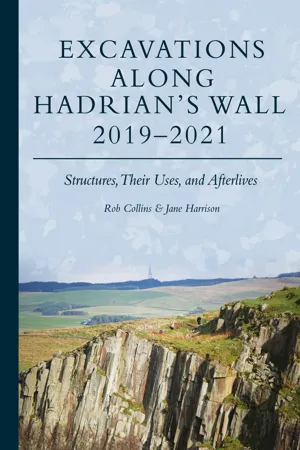
Excavations Along Hadrian’s Wall 2019–2021
Structures, Their Uses, and Afterlives
- 256 pages
- English
- ePUB (mobile friendly)
- Available on iOS & Android
eBook - ePub
Excavations Along Hadrian’s Wall 2019–2021
Structures, Their Uses, and Afterlives
About this book
Information
Subtopic
Roman Ancient HistoryIndex
Social SciencesTable of contents
- Front Cover
- Half-Title Page
- Title Page
- Copyright Page
- Contents
- List of figures
- List of tables
- Abbreviations
- Preface
- Acknowledgements
- 1. Introduction
- 2. The Vallum under pasture and under plough at Heddon
- 3. Geophysical survey of the curtain at Thirlwall and Drumburgh Alex Turner
- 4. The curtain at Port Carlisle: survey and excavation
- 5. The curtain at Walltown Crags: survey and excavation
- 6. The Wall-crossing at the Cam Beck: survey and excavation
- 7. Corbridge: survey and excavation
- 8. Conclusion
- Appendix 1: Contexts
- Appendix 2: Specialist report data
- Bibliography
Trusted by 375,005 students
Access to over 1.5 million titles for a fair monthly price.
Study more efficiently using our study tools.
Frequently asked questions
Yes, you can cancel anytime from the Subscription tab in your account settings on the Perlego website. Your subscription will stay active until the end of your current billing period. Learn how to cancel your subscription
No, books cannot be downloaded as external files, such as PDFs, for use outside of Perlego. However, you can download books within the Perlego app for offline reading on mobile or tablet. Learn how to download books offline
Perlego offers two plans: Essential and Complete
- Essential is ideal for learners and professionals who enjoy exploring a wide range of subjects. Access the Essential Library with 800,000+ trusted titles and best-sellers across business, personal growth, and the humanities. Includes unlimited reading time and Standard Read Aloud voice.
- Complete: Perfect for advanced learners and researchers needing full, unrestricted access. Unlock 1.5M+ books across hundreds of subjects, including academic and specialized titles. The Complete Plan also includes advanced features like Premium Read Aloud and Research Assistant.
We are an online textbook subscription service, where you can get access to an entire online library for less than the price of a single book per month. With over 1.5 million books across 990+ topics, we’ve got you covered! Learn about our mission
Look out for the read-aloud symbol on your next book to see if you can listen to it. The read-aloud tool reads text aloud for you, highlighting the text as it is being read. You can pause it, speed it up and slow it down. Learn more about Read Aloud
Yes! You can use the Perlego app on both iOS and Android devices to read anytime, anywhere — even offline. Perfect for commutes or when you’re on the go.
Please note we cannot support devices running on iOS 13 and Android 7 or earlier. Learn more about using the app
Please note we cannot support devices running on iOS 13 and Android 7 or earlier. Learn more about using the app
Yes, you can access Excavations Along Hadrian’s Wall 2019–2021 by Rob Collins,Jane Harrison in PDF and/or ePUB format, as well as other popular books in Social Sciences & Roman Ancient History. We have over 1.5 million books available in our catalogue for you to explore.